How to Book More Tattoo Clients Through Instagram DMs - 37 Tips

It's a Tuesday night. A potential client has been thinking about their first sleeve for a year. They finally feel ready.
They open Instagram, find two artists they love, and send a DM to both.
The second artist replies in 8 minutes. Asks the right questions. Sends two reference examples. Suggests a placement. Mentions a deposit. Books a date.
By the time the first artist sees their DM the next morning - between sessions, half-distracted - and types "hey, what tattoo do you want?" - that client is already gone. Deposit paid. Session booked. Someone else's client now.
The first artist didn't lose because their work was worse. They lost because their DM strategy was worse.
And this is happening more than you think. Every month, conversations that could have become bookings end in silence - and you never know why, because the client doesn't tell you. They just disappear.
This guide is the fix.
Why the "how much?" message is harder than it looks
The problem isn't the question. The problem is what most artists do when they get it.
They answer it.
A price with no context is a number floating in a void. The client has no frame for whether $1,200 is reasonable, expensive, or a bargain - because they don't yet understand what they're getting. So they go quiet. And the artist blames "cheap clients" when the real issue was sequencing.
There are four things quietly killing DM conversions for most tattoo artists:
- Answering instead of leading. When a client asks "how much?" they're actually asking "is this worth it for me?" Answering with a price skips the part where you help them decide. The artist who leads the conversation - asking about the concept, the placement, the vision - builds enough context that the price lands with weight instead of landing in silence.
- Treating every inquiry the same. A client planning a $3,000 sleeve and someone asking about a $150 name on their wrist are not the same conversation. The first needs to feel understood and guided. The second needs a clear answer and a gentle redirect if they're below your minimum. Running the same reply to both wastes time on one and loses the other.
- No follow-up after the quote. Around 50% of clients who go quiet after a price aren't gone - they're thinking. A few days later they're ready - and the artist they remember is the one who followed up. One message sent 48 hours after the quote recovers more deals than almost any other single change.
- No system. Your DM strategy lives in your head, which means it disappears the moment you're tired, in back-to-back sessions, or having a bad day. The artists with full calendars aren't necessarily better conversationalists - they have a repeatable structure they can run consistently.
That's what the next 37 tips build.
How to use this guide
Read it once end-to-end. Pick five tips that fit where you're losing conversations right now - those are your starter script.
Run it for seven days. Track one number: what percentage of DM conversations result in a paid deposit. That's the only metric that matters here.
The 37 tips are organized by the seven stages every booking conversation moves through.
Stage 1 - Mindset and setup (Tips 1–4)
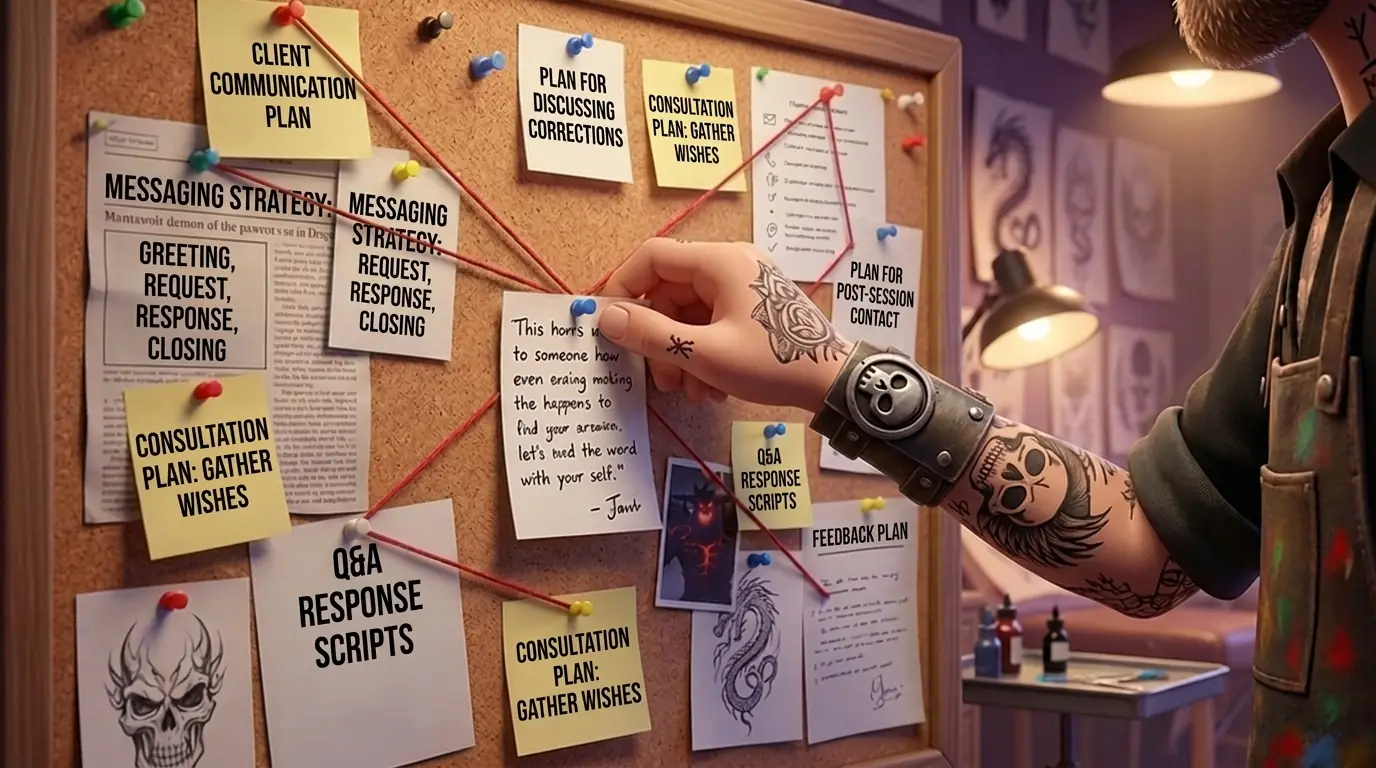
Tip 1 - You are not a vending machine. You are a consultant.
A vending machine answers "this tattoo costs $1,000." A consultant asks "tell me what you're trying to achieve, and I'll tell you the best way to do it." The framing changes everything - how you talk, how you're perceived, and what you can charge.
Tip 2 - The first reply needs to go out within 2–3 hours during waking hours.
Not after your session. Not tonight. 2–3 hours - and faster if you can. The artist who replies first wins most of the conversations - in our experience, it's rarely the one who waited until morning. If you physically can't reply within 2–3 hours during your working day, that's a capacity problem worth solving separately.
Tip 3 - Build a DM control center: three saved templates per stage.
You should never type the same opener twice. Save three versions of each common reply - greeting, asking for references, sending a quote, asking for the deposit. Personalize 20%, copy-paste 80%. This is not impersonal. This is professional.
Tip 4 - Decide your minimum project size before you open any DM.
If your floor is $400, write it down. Once it's written, you stop negotiating with $80 messages out of guilt. You either redirect them politely or decline. The decision made in advance is always cleaner than the one made in the moment.
Stage 2 - The first reply (Tips 5–10)
Tip 5 - Never start with a price. Ever.
Even when they ask for one in the first message. Especially then. A price without a conversation signals commodity. Commodity means you're competing on price, and there will always be someone cheaper.
Tip 6 - Open warm, lead immediately.
Bad: "Hi" / "$500" / "send pic."
Good: "Hey! Thanks for reaching out. Tell me a bit more about the idea - and if you have any references or saved images, send them my way."
You've thanked them, asked an open question, and asked for references. You've set the agenda without it feeling like an interrogation.
Tip 7 - Use the Concept → Placement → Size → Quote sequence. Always.
This is the structure that separates converted bookings from ghosted conversations. The price always comes last - after they've described what they want, after you've shown vision, after they're invested.
Tip 8 - Mirror their energy, but elevate their language.
If they wrote "yo wanna get a small thing on my arm" - don't reply formally. But don't match "yo" either. "Hey! Love the energy. Tell me what 'small thing' looks like in your head - any reference images?" You meet them where they are, then pull them slightly up.
Tip 9 - End every message with a question.
A message without a question is a dead end. Always leave the ball in their court with one clear, easy-to-answer question. One, not three.
Tip 10 - If you can't monitor your Instagram DMs on weekends and evenings, set an auto-reply.
In our experience, a 24-hour silence kills close to half of inbound inquiries. If you're in session: "Hey - I'm tattooing today and will get back to you tonight. In the meantime, send any references you have so I can prepare a proper reply." Now they're already doing the work before you've even seen the message.
Stage 3 - Concept exploration (Tips 11–15)
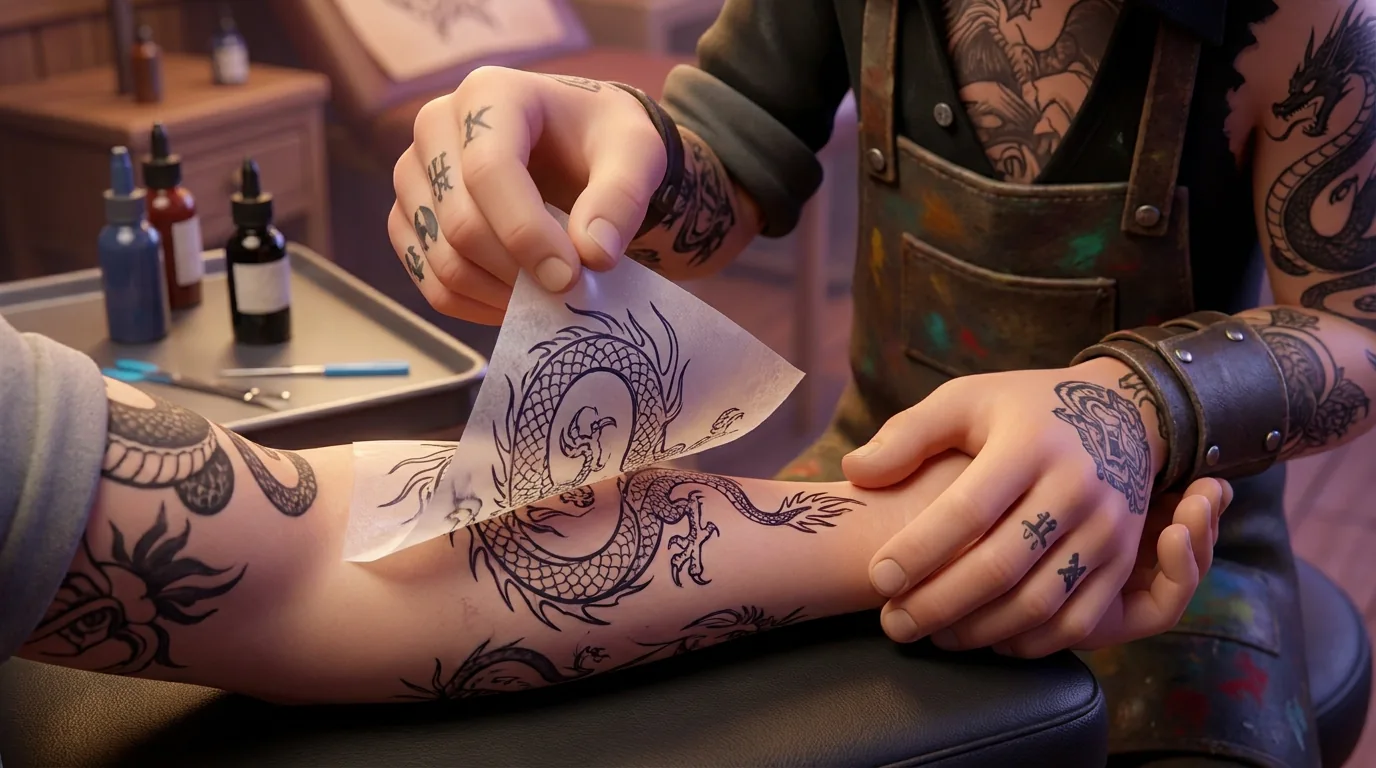
Tip 11 - Ask for references like a professional, not like a stranger.
"Do you already have a reference image, or are we creating something from scratch?" One sentence that sorts every client into one of two boxes you know how to handle.
Tip 12 - When they send a Pinterest screenshot, don't just say "ok cool."
Comment on it. "Love the line weight on this one - clean. The shading on the second feels more our style. We'd take the energy of these and make it custom for you, not a copy." This is where you demonstrate taste and build trust without mentioning price once.
Tip 13 - Translate their idea into your language.
Client: "I want something with a wave and my dog's name."
You: "Got it - a flowing, blackwork-style piece blending an ocean wave with subtle hand-lettering for the name. We can make this feel timeless rather than literal - does that direction feel right?"
You've shown vision. That's worth more than any technique on this list.
Tip 14 - Never criticize their idea, even when it's a bad one.
"Hmm, that's a tough one" kills the conversation. Instead: "That's a great starting point - let me show you a direction I think will age much better on the body." Redirect without rejecting. The client feels heard. The direction improves. Everyone wins.
Tip 15 - If they have no idea what they want, offer a consultation - don't demand one.
"For pieces like this, I usually offer a 20-minute consult - free, no commitment - so we can lock the concept together. Want me to send you a couple of times this week?" A consultation closes at roughly 80%. A price sent cold closes at roughly 15%.
Stage 4 - Placement, size, scope (Tips 16–19)
Tip 16 - Ask placement before size.
Placement determines size, not the other way around. "Where on the body are we placing this? That'll help me think through the flow and proportions."
Tip 17 - When they undersize the idea, expand it honestly.
"For the level of detail you're describing, the smallest size that holds up over five to ten years is around X inches. Anything smaller and the fine detail will blur. Want me to show you what that looks like at proper scale?" They're now thinking about a $1,500 piece instead of a $300 one - and you've been honest, not pushy.
Tip 18 - Confirm the scope back to them in writing before quoting.
"Just to confirm: blackwork wolf, forearm, roughly five inches, with smoke detail in the background. Is that right?" Two things happen: you prevent misalignment later, and they mentally commit to the vision before they hear the price.
Tip 19 - Decide whether it's a flat or project quote before you reply.
Have a clear internal rule before the conversation, not during it. Some artists charge per hour, some per session, some per project - it doesn't matter which, as long as you know your system before you open the DM. A price you calculate in real time feels uncertain. A price you state confidently feels earned.
Stage 5 - Talking about money (Tips 20–25)

This is where most conversions are won or lost. Read this section carefully.
Tip 20 - Frame the price inside value, never alone.
Bad: "$1,200."
Good: "For a piece this scale and detail - custom design, full-day session, and a follow-up touch-up after healing - the investment is $1,200. That covers everything from the first sketch to the finished result."
Same number. The context changes what it feels like to say yes.
Tip 21 - Use ranges only when you genuinely need more information.
"Pieces like this typically fall between $X and $Y depending on the final size and detail. Once you confirm placement and scale, I'll lock the exact number." Ranges create a soft anchor without committing before you have what you need.
Tip 22 - Never apologize for the price.
No "sorry, I know it's a lot." No "unfortunately my rate is." The moment you apologize, you signal that the price is wrong. State it. Stop talking. Wait.
Tip 23 - Handle "is that negotiable?" with confidence.
"My rates are fixed - they reflect the design time, the session, and the aftercare. What I can do is help you scope the piece to fit your budget. Want me to show you what we can build at $X?" You held the rate. You stayed in control. You gave them a path forward.
Tip 24 - When they say "that's more than I expected," don't drop the price - adjust the scope.
"Totally fair - let's look at the scope. We can either reduce the size and keep the detail, or simplify the detail and keep the size. Which feels closer to what you want?" You preserved your rate and made them feel heard. That's the move.
Tip 25 - If they go silent after the quote, don't panic.
Don't read it as rejection. Silence usually means they're weighing it - against their budget, their schedule, their priorities. The quote is still in their head. As we covered earlier - one follow-up message at 48 hours is your highest-leverage move.
Stage 6 - Closing the booking and taking the deposit (Tips 26–31)
Tip 26 - Always offer the next step. Never wait for them to ask.
Bad: "Let me know what you think!"
Good: "I have two openings that fit this piece - Friday the 14th at 11am, or Saturday the 22nd at 1pm. Which works better?" You replaced "if" with "when." That's the entire shift.
Tip 27 - Make the deposit feel like a benefit, not a barrier.
"To lock your spot, I take a $200 deposit - it goes toward your final cost, and it's what allows me to start your custom design work right away." Not "a deposit is required." The deposit is what unlocks something for them.
Tip 28 - Lead with one payment method. Mention the second only if asked.
Decision fatigue kills closes. Pick one default - Venmo, Stripe link, bank transfer - and lead with that. Listing five options creates hesitation where there should be momentum.
Tip 29 - Send the booking confirmation immediately with everything they need.
Date, time, address, what to eat that morning, prep instructions, deposit receipt. One message they can screenshot. This single step reduces no-shows by roughly 30%.
Tip 30 - When they hesitate at the deposit step, pull them back to the design.
"Totally - and once the deposit is in, I'll start the sketch this week so you can see the direction before the session. We'll go back and forth until it feels exactly right." You moved them from "spending money" to "getting something."
Tip 31 - Never let a soft yes sit longer than 24 hours.
"Yeah I think I want to do it" is not a booking. Within 24 hours: "Awesome - should I lock the Friday slot for you? Once I have the deposit I can send confirmation and start your sketch." Convert the soft yes before life happens to them.
Stage 7 - Follow-up (Tips 32–37)
Tip 32 - Follow up at 48 hours, then seven days, then 21 days.
Three touchpoints. After that, let it go. The seven-day follow-up alone recovers 20-25% of leads that appeared to be gone.
Tip 33 - Use this message at 48 hours:
"Hey - just bumping this up in case it got buried. Did you have a chance to think about the dates? I'd love to lock something in before my schedule fills for the month." Soft. One gentle note of time pressure. No guilt.
Tip 34 - Use this message at seven days:
"Hey - circling back. Totally understand if the timing isn't right yet. If you'd rather revisit this in a month or two, just let me know and I'll keep your concept on file." It gives them permission to re-engage without shame.
Tip 35 - Track one number for 30 days: the percentage of DM conversations that result in a paid deposit.
Write it down. Once that number stabilizes, you have a baseline. Everything from there is optimization.
Tip 36 - Once you're booked 30 days out consistently, raise your rates by 15–20%.
Not when you feel ready. Not when a friend tells you to. When the calendar tells you to. Demand is the only honest signal.
Tip 37 - Keep raising until roughly half of new inquiries say "let me think about it."
That's your true market ceiling. Below it, you're leaving money on the table. Above it, you're creating friction that slows the calendar. Around 50% hesitation means you've found your rate.
What changes when this becomes your system
Implement fifteen of these consistently - not all thirty-seven, just fifteen - and within sixty days most artists see the same few things happen.
The ghost rate drops. Conversations that used to die after the quote start closing. The average booking value goes up, not because you raised prices, but because you're framing value before the number lands. And the late-night anxiety about unanswered messages mostly disappears, because the structure exists whether or not you're at your best that day.
The first sign is usually small: a conversation that would have died on message four closes on message nine with a deposit. Then it happens again. Then it stops feeling like luck.
That’s the system we built for Lesha Misho in LA when his inbox started taking up more time than his tattooing hours.
The honest part
This guide fixes a real problem. It doesn't fix all of them.
The system works - but it only works on the conversations you're already having. If the DMs aren't coming in the first place, that's a different problem. And if they are coming in faster than one person can handle while also tattooing full days, designing, and trying to have a life - that's a different problem too.
Either way — if answering DMs is taking over your day, here’s how we take it off your plate.
How to Book More Tattoo Clients Through Instagram DMs - 37 Tips
It's a Tuesday night. A potential client has been thinking about their first sleeve for a year. They finally feel ready.
They open Instagram, find two artists they love, and send a DM to both.
The second artist replies in 8 minutes. Asks the right questions. Sends two reference examples. Suggests a placement. Mentions a deposit. Books a date.
By the time the first artist sees their DM the next morning - between sessions, half-distracted - and types "hey, what tattoo do you want?" - that client is already gone. Deposit paid. Session booked. Someone else's client now.
The first artist didn't lose because their work was worse. They lost because their DM strategy was worse.
And this is happening more than you think. Every month, conversations that could have become bookings end in silence - and you never know why, because the client doesn't tell you. They just disappear.
This guide is the fix.
Why the "how much?" message is harder than it looks
The problem isn't the question. The problem is what most artists do when they get it.
They answer it.
A price with no context is a number floating in a void. The client has no frame for whether $1,200 is reasonable, expensive, or a bargain - because they don't yet understand what they're getting. So they go quiet. And the artist blames "cheap clients" when the real issue was sequencing.
There are four things quietly killing DM conversions for most tattoo artists:
- Answering instead of leading. When a client asks "how much?" they're actually asking "is this worth it for me?" Answering with a price skips the part where you help them decide. The artist who leads the conversation - asking about the concept, the placement, the vision - builds enough context that the price lands with weight instead of landing in silence.
- Treating every inquiry the same. A client planning a $3,000 sleeve and someone asking about a $150 name on their wrist are not the same conversation. The first needs to feel understood and guided. The second needs a clear answer and a gentle redirect if they're below your minimum. Running the same reply to both wastes time on one and loses the other.
- No follow-up after the quote. Around 50% of clients who go quiet after a price aren't gone - they're thinking. A few days later they're ready - and the artist they remember is the one who followed up. One message sent 48 hours after the quote recovers more deals than almost any other single change.
- No system. Your DM strategy lives in your head, which means it disappears the moment you're tired, in back-to-back sessions, or having a bad day. The artists with full calendars aren't necessarily better conversationalists - they have a repeatable structure they can run consistently.
That's what the next 37 tips build.
How to use this guide
Read it once end-to-end. Pick five tips that fit where you're losing conversations right now - those are your starter script.
Run it for seven days. Track one number: what percentage of DM conversations result in a paid deposit. That's the only metric that matters here.
The 37 tips are organized by the seven stages every booking conversation moves through.
Stage 1 - Mindset and setup (Tips 1–4)
Tip 1 - You are not a vending machine. You are a consultant.
A vending machine answers "this tattoo costs $1,000." A consultant asks "tell me what you're trying to achieve, and I'll tell you the best way to do it." The framing changes everything - how you talk, how you're perceived, and what you can charge.
Tip 2 - The first reply needs to go out within 2–3 hours during waking hours.
Not after your session. Not tonight. 2–3 hours - and faster if you can. The artist who replies first wins most of the conversations - in our experience, it's rarely the one who waited until morning. If you physically can't reply within 2–3 hours during your working day, that's a capacity problem worth solving separately.
Tip 3 - Build a DM control center: three saved templates per stage.
You should never type the same opener twice. Save three versions of each common reply - greeting, asking for references, sending a quote, asking for the deposit. Personalize 20%, copy-paste 80%. This is not impersonal. This is professional.
Tip 4 - Decide your minimum project size before you open any DM.
If your floor is $400, write it down. Once it's written, you stop negotiating with $80 messages out of guilt. You either redirect them politely or decline. The decision made in advance is always cleaner than the one made in the moment.
Stage 2 - The first reply (Tips 5–10)
Tip 5 - Never start with a price. Ever.
Even when they ask for one in the first message. Especially then. A price without a conversation signals commodity. Commodity means you're competing on price, and there will always be someone cheaper.
Tip 6 - Open warm, lead immediately.
Bad: "Hi" / "$500" / "send pic."
Good: "Hey! Thanks for reaching out. Tell me a bit more about the idea - and if you have any references or saved images, send them my way."
You've thanked them, asked an open question, and asked for references. You've set the agenda without it feeling like an interrogation.
Tip 7 - Use the Concept → Placement → Size → Quote sequence. Always.
This is the structure that separates converted bookings from ghosted conversations. The price always comes last - after they've described what they want, after you've shown vision, after they're invested.
Tip 8 - Mirror their energy, but elevate their language.
If they wrote "yo wanna get a small thing on my arm" - don't reply formally. But don't match "yo" either. "Hey! Love the energy. Tell me what 'small thing' looks like in your head - any reference images?" You meet them where they are, then pull them slightly up.
Tip 9 - End every message with a question.
A message without a question is a dead end. Always leave the ball in their court with one clear, easy-to-answer question. One, not three.
Tip 10 - If you can't monitor your Instagram DMs on weekends and evenings, set an auto-reply.
In our experience, a 24-hour silence kills close to half of inbound inquiries. If you're in session: "Hey - I'm tattooing today and will get back to you tonight. In the meantime, send any references you have so I can prepare a proper reply." Now they're already doing the work before you've even seen the message.
Stage 3 - Concept exploration (Tips 11–15)
Tip 11 - Ask for references like a professional, not like a stranger.
"Do you already have a reference image, or are we creating something from scratch?" One sentence that sorts every client into one of two boxes you know how to handle.
Tip 12 - When they send a Pinterest screenshot, don't just say "ok cool."
Comment on it. "Love the line weight on this one - clean. The shading on the second feels more our style. We'd take the energy of these and make it custom for you, not a copy." This is where you demonstrate taste and build trust without mentioning price once.
Tip 13 - Translate their idea into your language.
Client: "I want something with a wave and my dog's name."
You: "Got it - a flowing, blackwork-style piece blending an ocean wave with subtle hand-lettering for the name. We can make this feel timeless rather than literal - does that direction feel right?"
You've shown vision. That's worth more than any technique on this list.
Tip 14 - Never criticize their idea, even when it's a bad one.
"Hmm, that's a tough one" kills the conversation. Instead: "That's a great starting point - let me show you a direction I think will age much better on the body." Redirect without rejecting. The client feels heard. The direction improves. Everyone wins.
Tip 15 - If they have no idea what they want, offer a consultation - don't demand one.
"For pieces like this, I usually offer a 20-minute consult - free, no commitment - so we can lock the concept together. Want me to send you a couple of times this week?" A consultation closes at roughly 80%. A price sent cold closes at roughly 15%.
Stage 4 - Placement, size, scope (Tips 16–19)
Tip 16 - Ask placement before size.
Placement determines size, not the other way around. "Where on the body are we placing this? That'll help me think through the flow and proportions."
Tip 17 - When they undersize the idea, expand it honestly.
"For the level of detail you're describing, the smallest size that holds up over five to ten years is around X inches. Anything smaller and the fine detail will blur. Want me to show you what that looks like at proper scale?" They're now thinking about a $1,500 piece instead of a $300 one - and you've been honest, not pushy.
Tip 18 - Confirm the scope back to them in writing before quoting.
"Just to confirm: blackwork wolf, forearm, roughly five inches, with smoke detail in the background. Is that right?" Two things happen: you prevent misalignment later, and they mentally commit to the vision before they hear the price.
Tip 19 - Decide whether it's a flat or project quote before you reply.
Have a clear internal rule before the conversation, not during it. Some artists charge per hour, some per session, some per project - it doesn't matter which, as long as you know your system before you open the DM. A price you calculate in real time feels uncertain. A price you state confidently feels earned.
Stage 5 - Talking about money (Tips 20–25)
This is where most conversions are won or lost. Read this section carefully.
Tip 20 - Frame the price inside value, never alone.
Bad: "$1,200."
Good: "For a piece this scale and detail - custom design, full-day session, and a follow-up touch-up after healing - the investment is $1,200. That covers everything from the first sketch to the finished result."
Same number. The context changes what it feels like to say yes.
Tip 21 - Use ranges only when you genuinely need more information.
"Pieces like this typically fall between $X and $Y depending on the final size and detail. Once you confirm placement and scale, I'll lock the exact number." Ranges create a soft anchor without committing before you have what you need.
Tip 22 - Never apologize for the price.
No "sorry, I know it's a lot." No "unfortunately my rate is." The moment you apologize, you signal that the price is wrong. State it. Stop talking. Wait.
Tip 23 - Handle "is that negotiable?" with confidence.
"My rates are fixed - they reflect the design time, the session, and the aftercare. What I can do is help you scope the piece to fit your budget. Want me to show you what we can build at $X?" You held the rate. You stayed in control. You gave them a path forward.
Tip 24 - When they say "that's more than I expected," don't drop the price - adjust the scope.
"Totally fair - let's look at the scope. We can either reduce the size and keep the detail, or simplify the detail and keep the size. Which feels closer to what you want?" You preserved your rate and made them feel heard. That's the move.
Tip 25 - If they go silent after the quote, don't panic.
Don't read it as rejection. Silence usually means they're weighing it - against their budget, their schedule, their priorities. The quote is still in their head. As we covered earlier - one follow-up message at 48 hours is your highest-leverage move.
Stage 6 - Closing the booking and taking the deposit (Tips 26–31)
Tip 26 - Always offer the next step. Never wait for them to ask.
Bad: "Let me know what you think!"
Good: "I have two openings that fit this piece - Friday the 14th at 11am, or Saturday the 22nd at 1pm. Which works better?" You replaced "if" with "when." That's the entire shift.
Tip 27 - Make the deposit feel like a benefit, not a barrier.
"To lock your spot, I take a $200 deposit - it goes toward your final cost, and it's what allows me to start your custom design work right away." Not "a deposit is required." The deposit is what unlocks something for them.
Tip 28 - Lead with one payment method. Mention the second only if asked.
Decision fatigue kills closes. Pick one default - Venmo, Stripe link, bank transfer - and lead with that. Listing five options creates hesitation where there should be momentum.
Tip 29 - Send the booking confirmation immediately with everything they need.
Date, time, address, what to eat that morning, prep instructions, deposit receipt. One message they can screenshot. This single step reduces no-shows by roughly 30%.
Tip 30 - When they hesitate at the deposit step, pull them back to the design.
"Totally - and once the deposit is in, I'll start the sketch this week so you can see the direction before the session. We'll go back and forth until it feels exactly right." You moved them from "spending money" to "getting something."
Tip 31 - Never let a soft yes sit longer than 24 hours.
"Yeah I think I want to do it" is not a booking. Within 24 hours: "Awesome - should I lock the Friday slot for you? Once I have the deposit I can send confirmation and start your sketch." Convert the soft yes before life happens to them.
Stage 7 - Follow-up (Tips 32–37)
Tip 32 - Follow up at 48 hours, then seven days, then 21 days.
Three touchpoints. After that, let it go. The seven-day follow-up alone recovers 20-25% of leads that appeared to be gone.
Tip 33 - Use this message at 48 hours:
"Hey - just bumping this up in case it got buried. Did you have a chance to think about the dates? I'd love to lock something in before my schedule fills for the month." Soft. One gentle note of time pressure. No guilt.
Tip 34 - Use this message at seven days:
"Hey - circling back. Totally understand if the timing isn't right yet. If you'd rather revisit this in a month or two, just let me know and I'll keep your concept on file." It gives them permission to re-engage without shame.
Tip 35 - Track one number for 30 days: the percentage of DM conversations that result in a paid deposit.
Write it down. Once that number stabilizes, you have a baseline. Everything from there is optimization.
Tip 36 - Once you're booked 30 days out consistently, raise your rates by 15–20%.
Not when you feel ready. Not when a friend tells you to. When the calendar tells you to. Demand is the only honest signal.
Tip 37 - Keep raising until roughly half of new inquiries say "let me think about it."
That's your true market ceiling. Below it, you're leaving money on the table. Above it, you're creating friction that slows the calendar. Around 50% hesitation means you've found your rate.
What changes when this becomes your system
Implement fifteen of these consistently - not all thirty-seven, just fifteen - and within sixty days most artists see the same few things happen.
The ghost rate drops. Conversations that used to die after the quote start closing. The average booking value goes up, not because you raised prices, but because you're framing value before the number lands. And the late-night anxiety about unanswered messages mostly disappears, because the structure exists whether or not you're at your best that day.
The first sign is usually small: a conversation that would have died on message four closes on message nine with a deposit. Then it happens again. Then it stops feeling like luck.
That’s the system we built for Lesha Misho in LA when his inbox started taking up more time than his tattooing hours.
The honest part
This guide fixes a real problem. It doesn't fix all of them.
The system works - but it only works on the conversations you're already having. If the DMs aren't coming in the first place, that's a different problem. And if they are coming in faster than one person can handle while also tattooing full days, designing, and trying to have a life - that's a different problem too.
Either way — if answering DMs is taking over your day, here’s how we take it off your plate.
How to Book More Tattoo Clients Through Instagram DMs - 37 Tips
It's a Tuesday night. A potential client has been thinking about their first sleeve for a year. They finally feel ready.
They open Instagram, find two artists they love, and send a DM to both.
The second artist replies in 8 minutes. Asks the right questions. Sends two reference examples. Suggests a placement. Mentions a deposit. Books a date.
By the time the first artist sees their DM the next morning - between sessions, half-distracted - and types "hey, what tattoo do you want?" - that client is already gone. Deposit paid. Session booked. Someone else's client now.
The first artist didn't lose because their work was worse. They lost because their DM strategy was worse.
And this is happening more than you think. Every month, conversations that could have become bookings end in silence - and you never know why, because the client doesn't tell you. They just disappear.
This guide is the fix.
Why the "how much?" message is harder than it looks
The problem isn't the question. The problem is what most artists do when they get it.
They answer it.
A price with no context is a number floating in a void. The client has no frame for whether $1,200 is reasonable, expensive, or a bargain - because they don't yet understand what they're getting. So they go quiet. And the artist blames "cheap clients" when the real issue was sequencing.
There are four things quietly killing DM conversions for most tattoo artists:
- Answering instead of leading. When a client asks "how much?" they're actually asking "is this worth it for me?" Answering with a price skips the part where you help them decide. The artist who leads the conversation - asking about the concept, the placement, the vision - builds enough context that the price lands with weight instead of landing in silence.
- Treating every inquiry the same. A client planning a $3,000 sleeve and someone asking about a $150 name on their wrist are not the same conversation. The first needs to feel understood and guided. The second needs a clear answer and a gentle redirect if they're below your minimum. Running the same reply to both wastes time on one and loses the other.
- No follow-up after the quote. Around 50% of clients who go quiet after a price aren't gone - they're thinking. A few days later they're ready - and the artist they remember is the one who followed up. One message sent 48 hours after the quote recovers more deals than almost any other single change.
- No system. Your DM strategy lives in your head, which means it disappears the moment you're tired, in back-to-back sessions, or having a bad day. The artists with full calendars aren't necessarily better conversationalists - they have a repeatable structure they can run consistently.
That's what the next 37 tips build.
How to use this guide
Read it once end-to-end. Pick five tips that fit where you're losing conversations right now - those are your starter script.
Run it for seven days. Track one number: what percentage of DM conversations result in a paid deposit. That's the only metric that matters here.
The 37 tips are organized by the seven stages every booking conversation moves through.
Stage 1 - Mindset and setup (Tips 1–4)
Tip 1 - You are not a vending machine. You are a consultant.
A vending machine answers "this tattoo costs $1,000." A consultant asks "tell me what you're trying to achieve, and I'll tell you the best way to do it." The framing changes everything - how you talk, how you're perceived, and what you can charge.
Tip 2 - The first reply needs to go out within 2–3 hours during waking hours.
Not after your session. Not tonight. 2–3 hours - and faster if you can. The artist who replies first wins most of the conversations - in our experience, it's rarely the one who waited until morning. If you physically can't reply within 2–3 hours during your working day, that's a capacity problem worth solving separately.
Tip 3 - Build a DM control center: three saved templates per stage.
You should never type the same opener twice. Save three versions of each common reply - greeting, asking for references, sending a quote, asking for the deposit. Personalize 20%, copy-paste 80%. This is not impersonal. This is professional.
Tip 4 - Decide your minimum project size before you open any DM.
If your floor is $400, write it down. Once it's written, you stop negotiating with $80 messages out of guilt. You either redirect them politely or decline. The decision made in advance is always cleaner than the one made in the moment.
Stage 2 - The first reply (Tips 5–10)
Tip 5 - Never start with a price. Ever.
Even when they ask for one in the first message. Especially then. A price without a conversation signals commodity. Commodity means you're competing on price, and there will always be someone cheaper.
Tip 6 - Open warm, lead immediately.
Bad: "Hi" / "$500" / "send pic."
Good: "Hey! Thanks for reaching out. Tell me a bit more about the idea - and if you have any references or saved images, send them my way."
You've thanked them, asked an open question, and asked for references. You've set the agenda without it feeling like an interrogation.
Tip 7 - Use the Concept → Placement → Size → Quote sequence. Always.
This is the structure that separates converted bookings from ghosted conversations. The price always comes last - after they've described what they want, after you've shown vision, after they're invested.
Tip 8 - Mirror their energy, but elevate their language.
If they wrote "yo wanna get a small thing on my arm" - don't reply formally. But don't match "yo" either. "Hey! Love the energy. Tell me what 'small thing' looks like in your head - any reference images?" You meet them where they are, then pull them slightly up.
Tip 9 - End every message with a question.
A message without a question is a dead end. Always leave the ball in their court with one clear, easy-to-answer question. One, not three.
Tip 10 - If you can't monitor your Instagram DMs on weekends and evenings, set an auto-reply.
In our experience, a 24-hour silence kills close to half of inbound inquiries. If you're in session: "Hey - I'm tattooing today and will get back to you tonight. In the meantime, send any references you have so I can prepare a proper reply." Now they're already doing the work before you've even seen the message.
Stage 3 - Concept exploration (Tips 11–15)
Tip 11 - Ask for references like a professional, not like a stranger.
"Do you already have a reference image, or are we creating something from scratch?" One sentence that sorts every client into one of two boxes you know how to handle.
Tip 12 - When they send a Pinterest screenshot, don't just say "ok cool."
Comment on it. "Love the line weight on this one - clean. The shading on the second feels more our style. We'd take the energy of these and make it custom for you, not a copy." This is where you demonstrate taste and build trust without mentioning price once.
Tip 13 - Translate their idea into your language.
Client: "I want something with a wave and my dog's name."
You: "Got it - a flowing, blackwork-style piece blending an ocean wave with subtle hand-lettering for the name. We can make this feel timeless rather than literal - does that direction feel right?"
You've shown vision. That's worth more than any technique on this list.
Tip 14 - Never criticize their idea, even when it's a bad one.
"Hmm, that's a tough one" kills the conversation. Instead: "That's a great starting point - let me show you a direction I think will age much better on the body." Redirect without rejecting. The client feels heard. The direction improves. Everyone wins.
Tip 15 - If they have no idea what they want, offer a consultation - don't demand one.
"For pieces like this, I usually offer a 20-minute consult - free, no commitment - so we can lock the concept together. Want me to send you a couple of times this week?" A consultation closes at roughly 80%. A price sent cold closes at roughly 15%.
Stage 4 - Placement, size, scope (Tips 16–19)
Tip 16 - Ask placement before size.
Placement determines size, not the other way around. "Where on the body are we placing this? That'll help me think through the flow and proportions."
Tip 17 - When they undersize the idea, expand it honestly.
"For the level of detail you're describing, the smallest size that holds up over five to ten years is around X inches. Anything smaller and the fine detail will blur. Want me to show you what that looks like at proper scale?" They're now thinking about a $1,500 piece instead of a $300 one - and you've been honest, not pushy.
Tip 18 - Confirm the scope back to them in writing before quoting.
"Just to confirm: blackwork wolf, forearm, roughly five inches, with smoke detail in the background. Is that right?" Two things happen: you prevent misalignment later, and they mentally commit to the vision before they hear the price.
Tip 19 - Decide whether it's a flat or project quote before you reply.
Have a clear internal rule before the conversation, not during it. Some artists charge per hour, some per session, some per project - it doesn't matter which, as long as you know your system before you open the DM. A price you calculate in real time feels uncertain. A price you state confidently feels earned.
Stage 5 - Talking about money (Tips 20–25)
This is where most conversions are won or lost. Read this section carefully.
Tip 20 - Frame the price inside value, never alone.
Bad: "$1,200."
Good: "For a piece this scale and detail - custom design, full-day session, and a follow-up touch-up after healing - the investment is $1,200. That covers everything from the first sketch to the finished result."
Same number. The context changes what it feels like to say yes.
Tip 21 - Use ranges only when you genuinely need more information.
"Pieces like this typically fall between $X and $Y depending on the final size and detail. Once you confirm placement and scale, I'll lock the exact number." Ranges create a soft anchor without committing before you have what you need.
Tip 22 - Never apologize for the price.
No "sorry, I know it's a lot." No "unfortunately my rate is." The moment you apologize, you signal that the price is wrong. State it. Stop talking. Wait.
Tip 23 - Handle "is that negotiable?" with confidence.
"My rates are fixed - they reflect the design time, the session, and the aftercare. What I can do is help you scope the piece to fit your budget. Want me to show you what we can build at $X?" You held the rate. You stayed in control. You gave them a path forward.
Tip 24 - When they say "that's more than I expected," don't drop the price - adjust the scope.
"Totally fair - let's look at the scope. We can either reduce the size and keep the detail, or simplify the detail and keep the size. Which feels closer to what you want?" You preserved your rate and made them feel heard. That's the move.
Tip 25 - If they go silent after the quote, don't panic.
Don't read it as rejection. Silence usually means they're weighing it - against their budget, their schedule, their priorities. The quote is still in their head. As we covered earlier - one follow-up message at 48 hours is your highest-leverage move.
Stage 6 - Closing the booking and taking the deposit (Tips 26–31)
Tip 26 - Always offer the next step. Never wait for them to ask.
Bad: "Let me know what you think!"
Good: "I have two openings that fit this piece - Friday the 14th at 11am, or Saturday the 22nd at 1pm. Which works better?" You replaced "if" with "when." That's the entire shift.
Tip 27 - Make the deposit feel like a benefit, not a barrier.
"To lock your spot, I take a $200 deposit - it goes toward your final cost, and it's what allows me to start your custom design work right away." Not "a deposit is required." The deposit is what unlocks something for them.
Tip 28 - Lead with one payment method. Mention the second only if asked.
Decision fatigue kills closes. Pick one default - Venmo, Stripe link, bank transfer - and lead with that. Listing five options creates hesitation where there should be momentum.
Tip 29 - Send the booking confirmation immediately with everything they need.
Date, time, address, what to eat that morning, prep instructions, deposit receipt. One message they can screenshot. This single step reduces no-shows by roughly 30%.
Tip 30 - When they hesitate at the deposit step, pull them back to the design.
"Totally - and once the deposit is in, I'll start the sketch this week so you can see the direction before the session. We'll go back and forth until it feels exactly right." You moved them from "spending money" to "getting something."
Tip 31 - Never let a soft yes sit longer than 24 hours.
"Yeah I think I want to do it" is not a booking. Within 24 hours: "Awesome - should I lock the Friday slot for you? Once I have the deposit I can send confirmation and start your sketch." Convert the soft yes before life happens to them.
Stage 7 - Follow-up (Tips 32–37)
Tip 32 - Follow up at 48 hours, then seven days, then 21 days.
Three touchpoints. After that, let it go. The seven-day follow-up alone recovers 20-25% of leads that appeared to be gone.
Tip 33 - Use this message at 48 hours:
"Hey - just bumping this up in case it got buried. Did you have a chance to think about the dates? I'd love to lock something in before my schedule fills for the month." Soft. One gentle note of time pressure. No guilt.
Tip 34 - Use this message at seven days:
"Hey - circling back. Totally understand if the timing isn't right yet. If you'd rather revisit this in a month or two, just let me know and I'll keep your concept on file." It gives them permission to re-engage without shame.
Tip 35 - Track one number for 30 days: the percentage of DM conversations that result in a paid deposit.
Write it down. Once that number stabilizes, you have a baseline. Everything from there is optimization.
Tip 36 - Once you're booked 30 days out consistently, raise your rates by 15–20%.
Not when you feel ready. Not when a friend tells you to. When the calendar tells you to. Demand is the only honest signal.
Tip 37 - Keep raising until roughly half of new inquiries say "let me think about it."
That's your true market ceiling. Below it, you're leaving money on the table. Above it, you're creating friction that slows the calendar. Around 50% hesitation means you've found your rate.
What changes when this becomes your system
Implement fifteen of these consistently - not all thirty-seven, just fifteen - and within sixty days most artists see the same few things happen.
The ghost rate drops. Conversations that used to die after the quote start closing. The average booking value goes up, not because you raised prices, but because you're framing value before the number lands. And the late-night anxiety about unanswered messages mostly disappears, because the structure exists whether or not you're at your best that day.
The first sign is usually small: a conversation that would have died on message four closes on message nine with a deposit. Then it happens again. Then it stops feeling like luck.
That’s the system we built for Lesha Misho in LA when his inbox started taking up more time than his tattooing hours.
The honest part
This guide fixes a real problem. It doesn't fix all of them.
The system works - but it only works on the conversations you're already having. If the DMs aren't coming in the first place, that's a different problem. And if they are coming in faster than one person can handle while also tattooing full days, designing, and trying to have a life - that's a different problem too.
Either way — if answering DMs is taking over your day, here’s how we take it off your plate.
Keep reading
All stories →
No time to read right now?
Drop your email and we'll send the best growth playbooks, case breakdowns and booking tactics straight to your inbox. One sharp email, twice a month — no spam, unsubscribe anytime.
No time to read right now?
Drop your email and we'll send the best growth playbooks, case breakdowns and booking tactics straight to your inbox. One sharp email, twice a month — no spam, unsubscribe anytime.
No time to read right now?
Drop your email and we'll send the best growth playbooks, case breakdowns and booking tactics straight to your inbox. One sharp email, twice a month — no spam, unsubscribe anytime.