How to Use Meta Ads for Tattoo Artists (Step by Step)
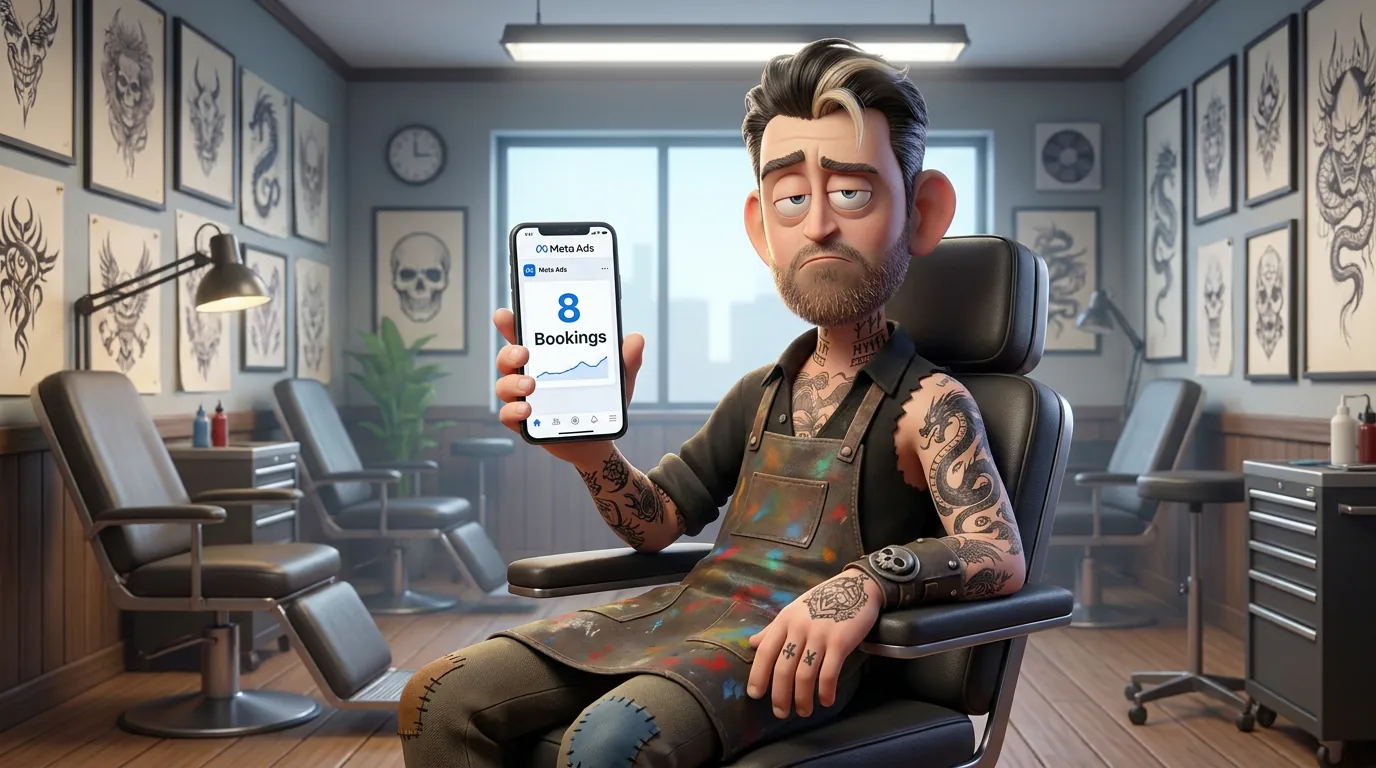
I've seen this pattern enough times that it stopped surprising me. A tattoo artist boosts a post, gets 3,000 impressions and zero bookings, and walks away convinced that ads don't work for artists.
Ads work. Randomly boosted posts rarely do.
The difference isn't budget - it's structure. Meta's advertising platform and the "Boost" button are technically the same tool, the way a scalpel and a kitchen knife are technically both knives. One is built for precision. The other will get the job done on bread.
This article covers how Meta ads function for tattoo artists - what campaign structure works, what creative converts, how to target without wasting spend, and what the numbers should look like when things are running well.
Why tattoo clients behave differently on Meta
Most artists I talk to expect Meta to bring clients fast. That's fair. But there's something worth understanding first.
Tattoo clients don't book on impulse. They scroll, they save, they follow, they think about it for a few days - sometimes weeks, sometimes months - and only then reach out.
Understanding this before you run ads changes everything. It tells you what Meta can and can't do. You're not going to close someone who hasn't even decided what tattoo they want yet. But you can start working on them now - so that two months from now, you're the artist they trust.
The artists who get this run their campaigns differently. Let me show you what I mean.
Two campaigns, one goal
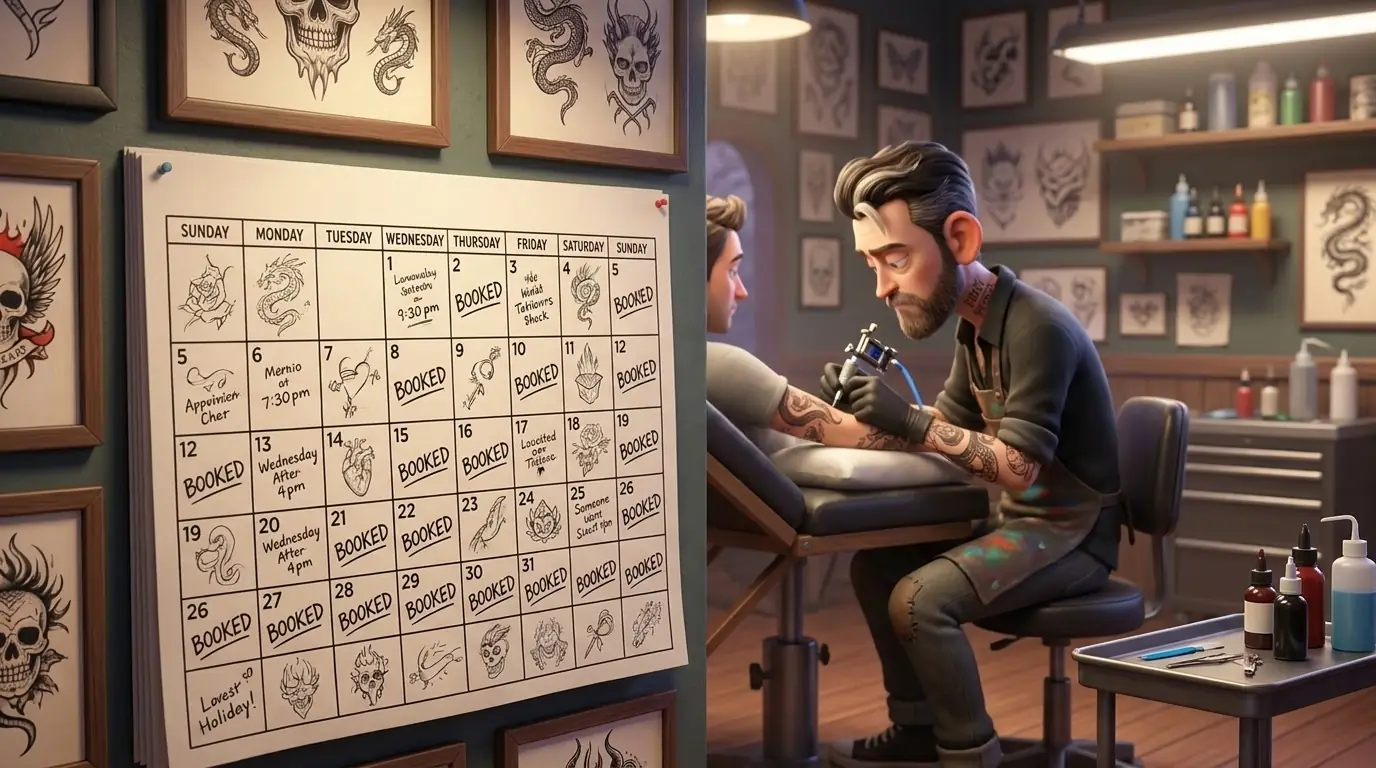
Effective Meta advertising for tattoo artists runs two campaigns simultaneously - not because one isn't enough, but because they bring clients in from different directions. Together they cover more ground than either one alone.
Campaign one - for people ready right now.
Run it straight to DMs. The person who sees your ad already has a style in mind, already knows roughly what they want - and your work just showed up in their feed. That's your hottest lead. Don't send them to a website. Don't ask them to fill out a form. Get them into a conversation, find out what they want, and close on a deposit. Consultation only if the project is complex enough to need one.
And set up a first message. I've watched too many artists lose bookings because the client waited three hours for a reply and moved on. Don't make that mistake.
Campaign two - for everyone else.
Profile traffic will do more than you expect. There's a large pool of people who already love your style - they just haven't committed to the idea yet. Every time they see your work, you get more fixed in their mind as the artist they'll go to when they're ready. And if your profile is set up right, you won't just wait for them - you'll accelerate the decision.
A lot of these people will start following you. Most artists ignore that. Don't. Send them a message first - something simple: "If you haven't figured out your tattoo idea yet, feel free to reach out - happy to help." It works. Artists who do this convert a good chunk of those followers into actual bookings.
The first campaign fills your calendar right now. The second builds the bookings that keep it full three months from now.
What creative converts
Creatives are where most people get stuck - especially when running ads for the first time. Here's what I'd start with:
Process video first. Time-lapse, close-up of linework, before-and-after reveal - these consistently outperform photos of finished work. Video holds attention longer, the algorithm notices, and the viewer actually watches instead of just scrolling past.
Put yourself in the frame. Talking to camera, mid-session, explaining your work - it doesn't matter. People book artists, not just tattoos. If they never see you, they have no reason to trust you over anyone else.
Tell the story behind the piece. A caption explaining why someone got a tattoo does more than a technical showcase of the same work. People love tattoos - but they love even more meaning behind them. Give them that.
Hook in the first two seconds. "She wanted to cover something up. Here's what we did instead." beats "Check out this coverup I just finished" every single time. The hook determines whether anyone sees the rest.
That said - no rule holds across every account. We've seen video win one month and static win the next, sometimes on the same account. Test it, look at the actual numbers, and let the data tell you what works for your audience. If you want to see what performs in practice, here are 12 real creative examples from tattoo campaigns we've run.
Targeting: what works
Creatives get most of the attention - but the technical side matters just as much. And while it sounds intimidating, setting it up yourself is easier than you think!
Location first. Your clients have to physically get to you. 10–15 miles for urban areas, up to 40 for smaller markets. Start here before touching anything else.
Demographics - don't overthink it. Set age and gender only if you have real data from existing clients. Otherwise let the algorithm work. It's better at finding the right people than most artists expect.
Interests - the biggest myth in tattoo advertising. "Tattoos," "body art," "tattoo culture" - sounds logical. Rarely outperforms broad targeting. These categories catch people who clicked on tattoo content once, not people ready to book. Let the algorithm read your creative and find its own signal. In most local markets, broad wins.
Lookalikes - use them once you have the data. Build from your Instagram followers or past clients. 100–300 people minimum in the source audience. These convert better than cold interest-based audiences because Meta already knows who your real clients look like.
And that's it. Not that hard, right? Now let's talk about something more important.
The numbers: what good looks like
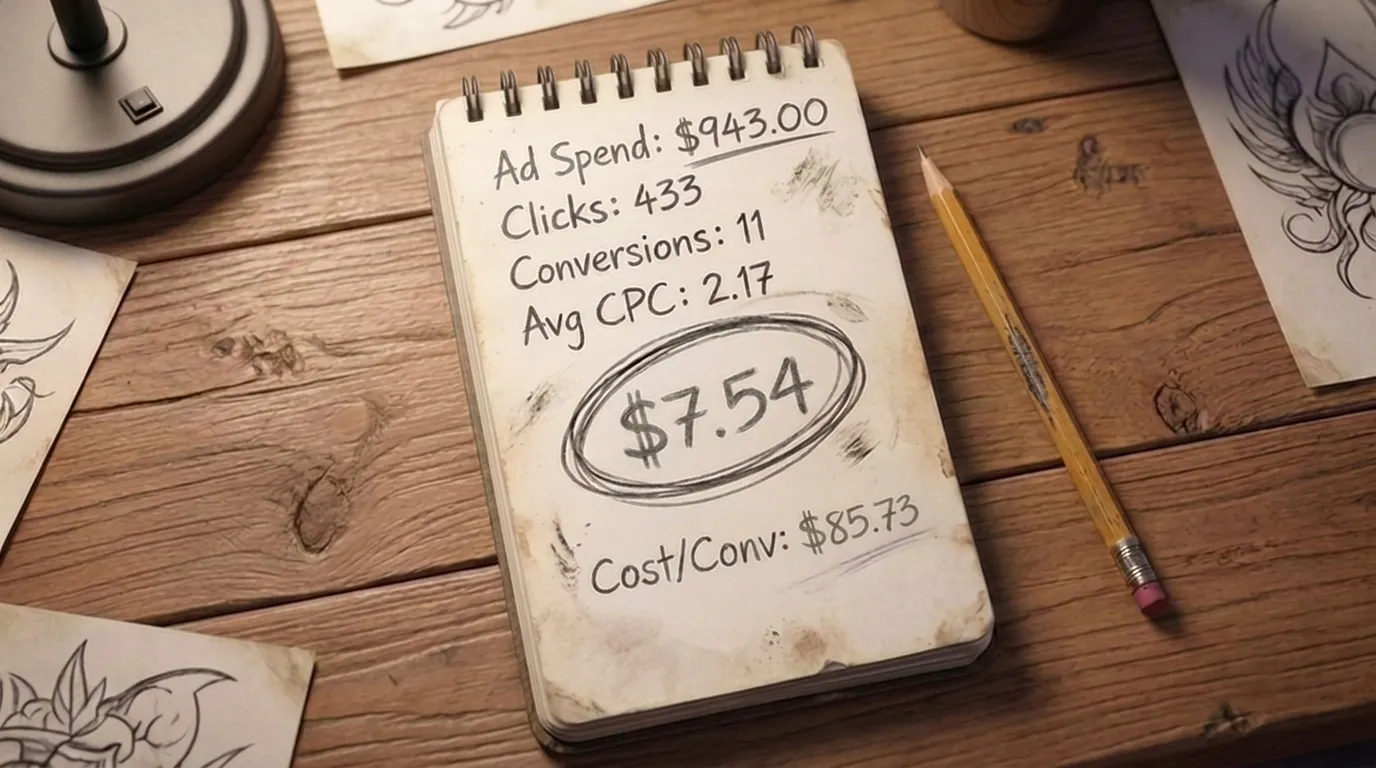
Results vary by market, style, and creative quality - but here are realistic benchmarks for campaigns that are working.
For conversation campaigns, cost per initiated conversation typically runs $2–3 for artists doing smaller pieces, and $8–10 for larger, high-commitment work. The gap makes sense - clients considering a small tattoo need less convincing to start a chat. Not every conversation becomes a booking - but a well-structured opening message and fast reply time can convert up to 20–30% of initiated conversations into a serious inquiry.
The metric that matters most across both campaigns is cost per booked deposit. Everything else is a proxy. If you're not connecting your ad spend to actual deposits, you don't know what's working. Our campaign for Ariel Ramon in Utica, NY is a good example of what the numbers look like when everything clicks - full breakdown here.
Common mistakes
- No automated opener on conversation campaigns. Starting a conversation campaign without a first message means people initiate a chat and hit silence. A simple automated question keeps them engaged until you pick it up. Without it, a significant portion leave before anyone responds.
- Sending ad traffic to an unprepared profile. If someone clicks your ad and lands on a profile with inconsistent posting, no clear style direction, and a bio that doesn't tell them what to do next - the ad money was wasted. The ad got them there. The profile lost them.
- Changing campaigns too quickly. Meta's algorithm needs time to optimize. Killing a campaign after three days because it hasn't booked anyone yet is how you throw away data. Give new campaigns two to three weeks and a minimum of $100–$150 in spend before drawing conclusions.
- Targeting too narrowly. Stacking five interest categories, a tight age range, and a small geographic radius leaves the algorithm with too small an audience to optimize. Broader targeting almost always outperforms heavily restricted audiences - especially when you're running conversation campaigns where Meta needs room to find the right people.
Just give it a chance
Most artists read something like this and think: "interesting, I'll try it." They run it for four days, see no bookings, and go back to running no ads at all.
The problem is almost never the platform. It's the setup and knowing what to measure. You can see 3,000 impressions. You can see conversations that didn't convert. What you can't see is the person who saved your post on Tuesday, read through your profile, and sent you a DM on Wednesday ready to book. If that's not happening - the campaign isn't set up right.
Get the setup right, track the right numbers, and Meta becomes one of the most predictable ways to fill a calendar.
If you'd rather have someone run it for you - here's how we do it.
How to Use Meta Ads for Tattoo Artists (Step by Step)
I've seen this pattern enough times that it stopped surprising me. A tattoo artist boosts a post, gets 3,000 impressions and zero bookings, and walks away convinced that ads don't work for artists.
Ads work. Randomly boosted posts rarely do.
The difference isn't budget - it's structure. Meta's advertising platform and the "Boost" button are technically the same tool, the way a scalpel and a kitchen knife are technically both knives. One is built for precision. The other will get the job done on bread.
This article covers how Meta ads function for tattoo artists - what campaign structure works, what creative converts, how to target without wasting spend, and what the numbers should look like when things are running well.
Why tattoo clients behave differently on Meta
Most artists I talk to expect Meta to bring clients fast. That's fair. But there's something worth understanding first.
Tattoo clients don't book on impulse. They scroll, they save, they follow, they think about it for a few days - sometimes weeks, sometimes months - and only then reach out.
Understanding this before you run ads changes everything. It tells you what Meta can and can't do. You're not going to close someone who hasn't even decided what tattoo they want yet. But you can start working on them now - so that two months from now, you're the artist they trust.
The artists who get this run their campaigns differently. Let me show you what I mean.
Two campaigns, one goal
Effective Meta advertising for tattoo artists runs two campaigns simultaneously - not because one isn't enough, but because they bring clients in from different directions. Together they cover more ground than either one alone.
Campaign one - for people ready right now.
Run it straight to DMs. The person who sees your ad already has a style in mind, already knows roughly what they want - and your work just showed up in their feed. That's your hottest lead. Don't send them to a website. Don't ask them to fill out a form. Get them into a conversation, find out what they want, and close on a deposit. Consultation only if the project is complex enough to need one.
And set up a first message. I've watched too many artists lose bookings because the client waited three hours for a reply and moved on. Don't make that mistake.
Campaign two - for everyone else.
Profile traffic will do more than you expect. There's a large pool of people who already love your style - they just haven't committed to the idea yet. Every time they see your work, you get more fixed in their mind as the artist they'll go to when they're ready. And if your profile is set up right, you won't just wait for them - you'll accelerate the decision.
A lot of these people will start following you. Most artists ignore that. Don't. Send them a message first - something simple: "If you haven't figured out your tattoo idea yet, feel free to reach out - happy to help." It works. Artists who do this convert a good chunk of those followers into actual bookings.
The first campaign fills your calendar right now. The second builds the bookings that keep it full three months from now.
What creative converts
Creatives are where most people get stuck - especially when running ads for the first time. Here's what I'd start with:
Process video first. Time-lapse, close-up of linework, before-and-after reveal - these consistently outperform photos of finished work. Video holds attention longer, the algorithm notices, and the viewer actually watches instead of just scrolling past.
Put yourself in the frame. Talking to camera, mid-session, explaining your work - it doesn't matter. People book artists, not just tattoos. If they never see you, they have no reason to trust you over anyone else.
Tell the story behind the piece. A caption explaining why someone got a tattoo does more than a technical showcase of the same work. People love tattoos - but they love even more meaning behind them. Give them that.
Hook in the first two seconds. "She wanted to cover something up. Here's what we did instead." beats "Check out this coverup I just finished" every single time. The hook determines whether anyone sees the rest.
That said - no rule holds across every account. We've seen video win one month and static win the next, sometimes on the same account. Test it, look at the actual numbers, and let the data tell you what works for your audience. If you want to see what performs in practice, here are 12 real creative examples from tattoo campaigns we've run.
Targeting: what works
Creatives get most of the attention - but the technical side matters just as much. And while it sounds intimidating, setting it up yourself is easier than you think!
Location first. Your clients have to physically get to you. 10–15 miles for urban areas, up to 40 for smaller markets. Start here before touching anything else.
Demographics - don't overthink it. Set age and gender only if you have real data from existing clients. Otherwise let the algorithm work. It's better at finding the right people than most artists expect.
Interests - the biggest myth in tattoo advertising. "Tattoos," "body art," "tattoo culture" - sounds logical. Rarely outperforms broad targeting. These categories catch people who clicked on tattoo content once, not people ready to book. Let the algorithm read your creative and find its own signal. In most local markets, broad wins.
Lookalikes - use them once you have the data. Build from your Instagram followers or past clients. 100–300 people minimum in the source audience. These convert better than cold interest-based audiences because Meta already knows who your real clients look like.
And that's it. Not that hard, right? Now let's talk about something more important.
The numbers: what good looks like
Results vary by market, style, and creative quality - but here are realistic benchmarks for campaigns that are working.
For conversation campaigns, cost per initiated conversation typically runs $2–3 for artists doing smaller pieces, and $8–10 for larger, high-commitment work. The gap makes sense - clients considering a small tattoo need less convincing to start a chat. Not every conversation becomes a booking - but a well-structured opening message and fast reply time can convert up to 20–30% of initiated conversations into a serious inquiry.
The metric that matters most across both campaigns is cost per booked deposit. Everything else is a proxy. If you're not connecting your ad spend to actual deposits, you don't know what's working. Our campaign for Ariel Ramon in Utica, NY is a good example of what the numbers look like when everything clicks - full breakdown here.
Common mistakes
- No automated opener on conversation campaigns. Starting a conversation campaign without a first message means people initiate a chat and hit silence. A simple automated question keeps them engaged until you pick it up. Without it, a significant portion leave before anyone responds.
- Sending ad traffic to an unprepared profile. If someone clicks your ad and lands on a profile with inconsistent posting, no clear style direction, and a bio that doesn't tell them what to do next - the ad money was wasted. The ad got them there. The profile lost them.
- Changing campaigns too quickly. Meta's algorithm needs time to optimize. Killing a campaign after three days because it hasn't booked anyone yet is how you throw away data. Give new campaigns two to three weeks and a minimum of $100–$150 in spend before drawing conclusions.
- Targeting too narrowly. Stacking five interest categories, a tight age range, and a small geographic radius leaves the algorithm with too small an audience to optimize. Broader targeting almost always outperforms heavily restricted audiences - especially when you're running conversation campaigns where Meta needs room to find the right people.
Just give it a chance
Most artists read something like this and think: "interesting, I'll try it." They run it for four days, see no bookings, and go back to running no ads at all.
The problem is almost never the platform. It's the setup and knowing what to measure. You can see 3,000 impressions. You can see conversations that didn't convert. What you can't see is the person who saved your post on Tuesday, read through your profile, and sent you a DM on Wednesday ready to book. If that's not happening - the campaign isn't set up right.
Get the setup right, track the right numbers, and Meta becomes one of the most predictable ways to fill a calendar.
If you'd rather have someone run it for you - here's how we do it.
How to Use Meta Ads for Tattoo Artists (Step by Step)
I've seen this pattern enough times that it stopped surprising me. A tattoo artist boosts a post, gets 3,000 impressions and zero bookings, and walks away convinced that ads don't work for artists.
Ads work. Randomly boosted posts rarely do.
The difference isn't budget - it's structure. Meta's advertising platform and the "Boost" button are technically the same tool, the way a scalpel and a kitchen knife are technically both knives. One is built for precision. The other will get the job done on bread.
This article covers how Meta ads function for tattoo artists - what campaign structure works, what creative converts, how to target without wasting spend, and what the numbers should look like when things are running well.
Why tattoo clients behave differently on Meta
Most artists I talk to expect Meta to bring clients fast. That's fair. But there's something worth understanding first.
Tattoo clients don't book on impulse. They scroll, they save, they follow, they think about it for a few days - sometimes weeks, sometimes months - and only then reach out.
Understanding this before you run ads changes everything. It tells you what Meta can and can't do. You're not going to close someone who hasn't even decided what tattoo they want yet. But you can start working on them now - so that two months from now, you're the artist they trust.
The artists who get this run their campaigns differently. Let me show you what I mean.
Two campaigns, one goal
Effective Meta advertising for tattoo artists runs two campaigns simultaneously - not because one isn't enough, but because they bring clients in from different directions. Together they cover more ground than either one alone.
Campaign one - for people ready right now.
Run it straight to DMs. The person who sees your ad already has a style in mind, already knows roughly what they want - and your work just showed up in their feed. That's your hottest lead. Don't send them to a website. Don't ask them to fill out a form. Get them into a conversation, find out what they want, and close on a deposit. Consultation only if the project is complex enough to need one.
And set up a first message. I've watched too many artists lose bookings because the client waited three hours for a reply and moved on. Don't make that mistake.
Campaign two - for everyone else.
Profile traffic will do more than you expect. There's a large pool of people who already love your style - they just haven't committed to the idea yet. Every time they see your work, you get more fixed in their mind as the artist they'll go to when they're ready. And if your profile is set up right, you won't just wait for them - you'll accelerate the decision.
A lot of these people will start following you. Most artists ignore that. Don't. Send them a message first - something simple: "If you haven't figured out your tattoo idea yet, feel free to reach out - happy to help." It works. Artists who do this convert a good chunk of those followers into actual bookings.
The first campaign fills your calendar right now. The second builds the bookings that keep it full three months from now.
What creative converts
Creatives are where most people get stuck - especially when running ads for the first time. Here's what I'd start with:
Process video first. Time-lapse, close-up of linework, before-and-after reveal - these consistently outperform photos of finished work. Video holds attention longer, the algorithm notices, and the viewer actually watches instead of just scrolling past.
Put yourself in the frame. Talking to camera, mid-session, explaining your work - it doesn't matter. People book artists, not just tattoos. If they never see you, they have no reason to trust you over anyone else.
Tell the story behind the piece. A caption explaining why someone got a tattoo does more than a technical showcase of the same work. People love tattoos - but they love even more meaning behind them. Give them that.
Hook in the first two seconds. "She wanted to cover something up. Here's what we did instead." beats "Check out this coverup I just finished" every single time. The hook determines whether anyone sees the rest.
That said - no rule holds across every account. We've seen video win one month and static win the next, sometimes on the same account. Test it, look at the actual numbers, and let the data tell you what works for your audience. If you want to see what performs in practice, here are 12 real creative examples from tattoo campaigns we've run.
Targeting: what works
Creatives get most of the attention - but the technical side matters just as much. And while it sounds intimidating, setting it up yourself is easier than you think!
Location first. Your clients have to physically get to you. 10–15 miles for urban areas, up to 40 for smaller markets. Start here before touching anything else.
Demographics - don't overthink it. Set age and gender only if you have real data from existing clients. Otherwise let the algorithm work. It's better at finding the right people than most artists expect.
Interests - the biggest myth in tattoo advertising. "Tattoos," "body art," "tattoo culture" - sounds logical. Rarely outperforms broad targeting. These categories catch people who clicked on tattoo content once, not people ready to book. Let the algorithm read your creative and find its own signal. In most local markets, broad wins.
Lookalikes - use them once you have the data. Build from your Instagram followers or past clients. 100–300 people minimum in the source audience. These convert better than cold interest-based audiences because Meta already knows who your real clients look like.
And that's it. Not that hard, right? Now let's talk about something more important.
The numbers: what good looks like
Results vary by market, style, and creative quality - but here are realistic benchmarks for campaigns that are working.
For conversation campaigns, cost per initiated conversation typically runs $2–3 for artists doing smaller pieces, and $8–10 for larger, high-commitment work. The gap makes sense - clients considering a small tattoo need less convincing to start a chat. Not every conversation becomes a booking - but a well-structured opening message and fast reply time can convert up to 20–30% of initiated conversations into a serious inquiry.
The metric that matters most across both campaigns is cost per booked deposit. Everything else is a proxy. If you're not connecting your ad spend to actual deposits, you don't know what's working. Our campaign for Ariel Ramon in Utica, NY is a good example of what the numbers look like when everything clicks - full breakdown here.
Common mistakes
- No automated opener on conversation campaigns. Starting a conversation campaign without a first message means people initiate a chat and hit silence. A simple automated question keeps them engaged until you pick it up. Without it, a significant portion leave before anyone responds.
- Sending ad traffic to an unprepared profile. If someone clicks your ad and lands on a profile with inconsistent posting, no clear style direction, and a bio that doesn't tell them what to do next - the ad money was wasted. The ad got them there. The profile lost them.
- Changing campaigns too quickly. Meta's algorithm needs time to optimize. Killing a campaign after three days because it hasn't booked anyone yet is how you throw away data. Give new campaigns two to three weeks and a minimum of $100–$150 in spend before drawing conclusions.
- Targeting too narrowly. Stacking five interest categories, a tight age range, and a small geographic radius leaves the algorithm with too small an audience to optimize. Broader targeting almost always outperforms heavily restricted audiences - especially when you're running conversation campaigns where Meta needs room to find the right people.
Just give it a chance
Most artists read something like this and think: "interesting, I'll try it." They run it for four days, see no bookings, and go back to running no ads at all.
The problem is almost never the platform. It's the setup and knowing what to measure. You can see 3,000 impressions. You can see conversations that didn't convert. What you can't see is the person who saved your post on Tuesday, read through your profile, and sent you a DM on Wednesday ready to book. If that's not happening - the campaign isn't set up right.
Get the setup right, track the right numbers, and Meta becomes one of the most predictable ways to fill a calendar.
If you'd rather have someone run it for you - here's how we do it.
Keep reading
All stories →
No time to read right now?
Drop your email and we'll send the best growth playbooks, case breakdowns and booking tactics straight to your inbox. One sharp email, twice a month — no spam, unsubscribe anytime.
No time to read right now?
Drop your email and we'll send the best growth playbooks, case breakdowns and booking tactics straight to your inbox. One sharp email, twice a month — no spam, unsubscribe anytime.
No time to read right now?
Drop your email and we'll send the best growth playbooks, case breakdowns and booking tactics straight to your inbox. One sharp email, twice a month — no spam, unsubscribe anytime.