How to Run Ads for Tattoo Artists: The Complete Guide
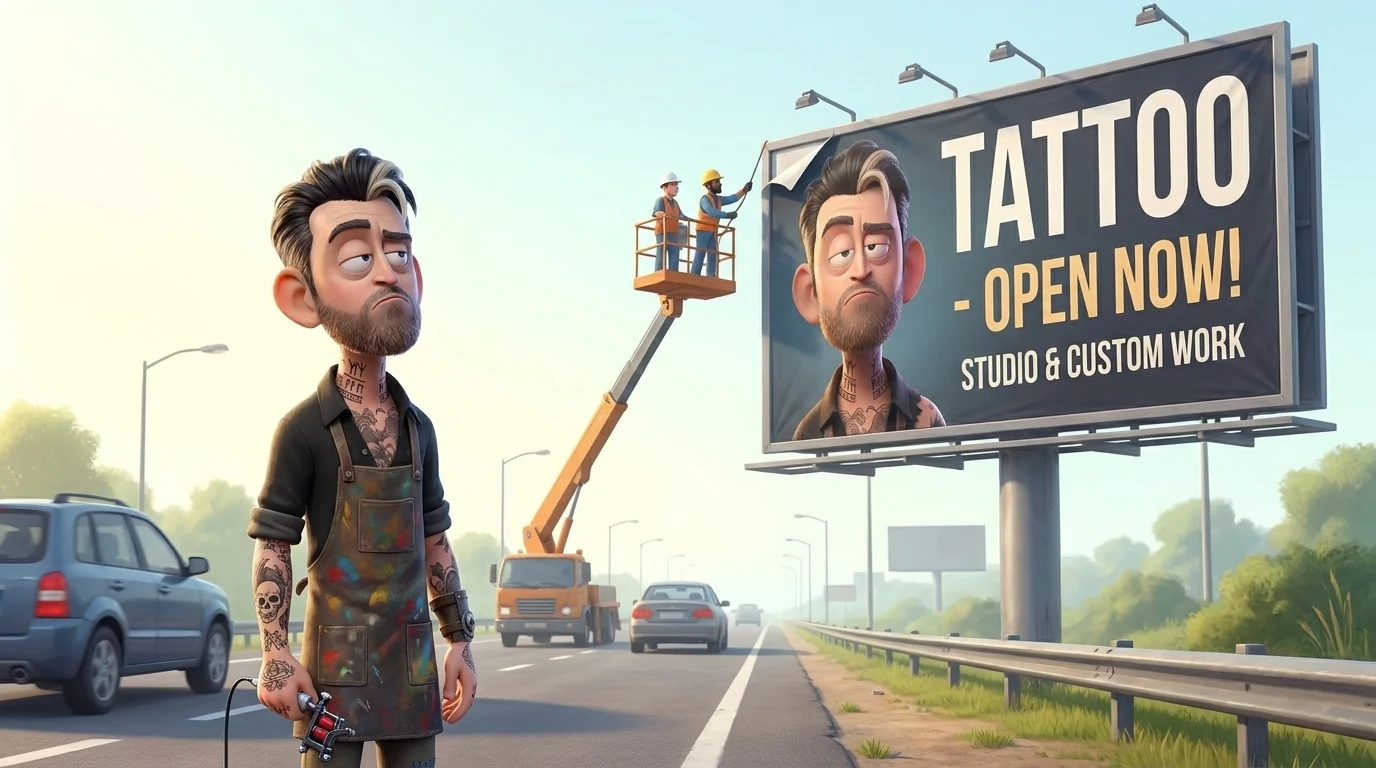
Most tattoo artists I talk to have the same problem: they don't know what next week looks like. A few weeks of bookings ahead at best - and plenty who genuinely don't know if they'll have clients at all.
Most have tried running ads - but "tried" usually means boosting a post for $50, watching it go nowhere, and writing off ads completely. Sound familiar? If that's your approach to advertising, you're better off spending that $50 on pizza and beer and having a good night instead.
But if you want to understand how advertising works - and you're not expecting to launch today and wake up booked three months out tomorrow - welcome to this guide.
Always look at the whole picture
People love giving the usual advice - and you actually can stick with them: "post more," "do your stories," "just boost a post," "add yourself to Google Maps." Will it work? Maybe. Maybe not. Maybe…
Before you follow anyone's advice, understand how your tattoo clients actually behave - and what types of clients exist. Without that, everything you try might bring clients in, or it might do absolutely nothing. And trust me, the second outcome is a lot more common than the first.
When it comes to advertising, most tattoo artists either don't believe it works - or if they try, 90% stop within the first week because they don't see results. Always keep this in mind: some clients are ready to book a session right now, some need help with the concept and they're yours the moment you offer it, and some will be thinking it over for days, weeks, or months. Your job as a tattoo artist is to become the obvious choice for all three. Build your advertising with that in mind - and everything starts to make more sense.
The Four Horsemen
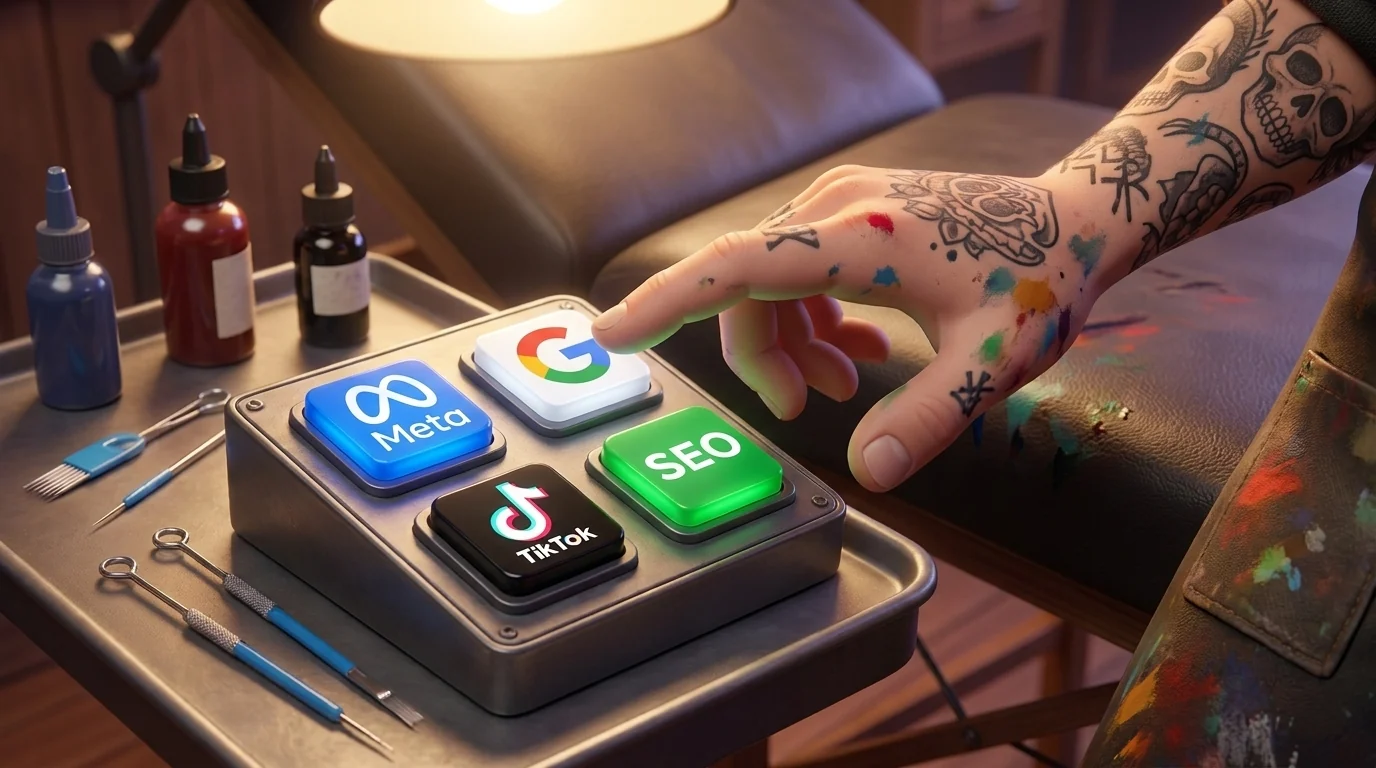
There are four channels worth your attention: Meta (mostly Instagram), Google, TikTok, and organic SEO. All of these channels work with clients at different stages - don't take all of them at once, don't even think about it. Your goal after reading this article is to pick one channel and start building it.
Because I know the type - the ones who decide to launch all four channels at the same time. You'll burn out, you'll get frustrated, and then you'll come back and tell me my advice is bad. If that's your plan, you might as well stop reading right now.
Meta Ads
Every tattoo artist is on Instagram. Every. Single. One. Because that's where clients find you most often. They come here, see beautiful work, get inspired, and reach out to the artists they like - and/or start following them.
What is Meta Ads for?
This is the channel that reaches all three types of clients I mentioned above. Some will book a session with you tomorrow after seeing your ad. Others will follow you and message you two months later for multiple sessions.
A lot of artists start with boosting posts. That's great - it means you're already taking action. Now let's go a little deeper. I always recommend a two-campaign structure set up through Meta Ads Manager:
The first campaign is focused on conversations - you're pulling in people who are already ready and will message you, discuss their idea, and most likely book.
The second campaign is profile traffic. This one works especially well with the second and third type of client - people who haven't finalized their concept yet, but you can already become their go-to choice down the road. Together these two campaigns create consistent, steady growth. I personally know a tattoo artist working in a city where the max rate was $1,500 for a full session. After six solid months of Meta ads, he's booked two months out - and he's the first artist in that city charging $1,800.
I won't go into every detail about Meta here - I want to introduce you to each channel first. But if you want to go deeper on this one specifically, go here.
What it costs
Meta ads for tattoo artists typically run between $10–$30 per day for local campaigns. Cost per lead varies widely - artists doing smaller pieces regularly see leads at $3–5. For larger, high-commitment work, expect $8–10. If your numbers are higher than that, the issue is almost always the ad creatives - that's the first place I'd look.
Google Ads
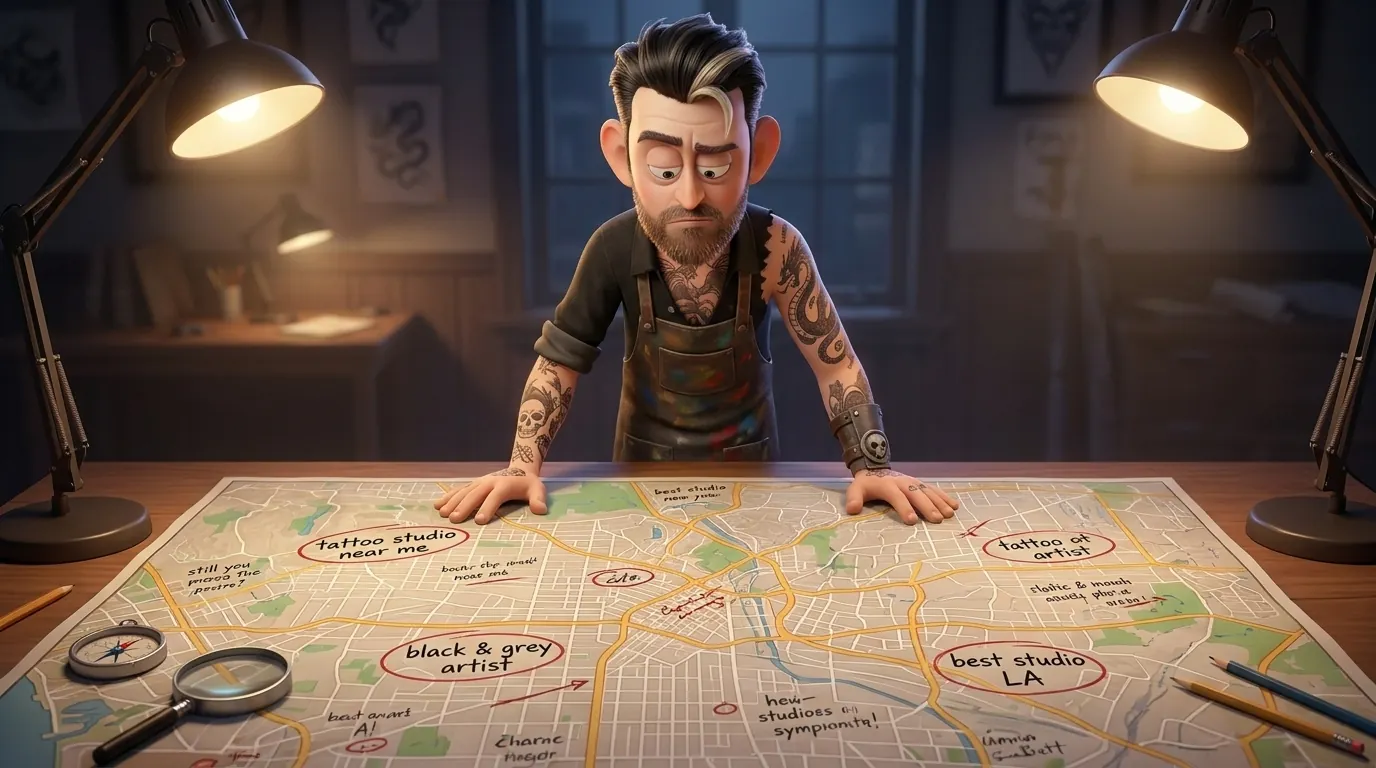
Right now, somewhere in your area, multiple people searched "black & grey tattoo artist near me" today. And you didn't show up. Okay, okay - you'll say "well, that's not my style." And I'll say there were searches for every other style too. You weren't there either.
Google Ads is built specifically for that first type of client - the ones who have been ready to get tattooed for a while and are actively looking for someone to trust with it right now.
Where do I even start?
Google has a lot of campaign types, but as a tattoo artist, focus on one only - Search. You don't need to run multiple campaign types, chase potential clients on YouTube, or build complex funnels where you show up 15 times across different websites before someone finally fills out a form. Don't overcomplicate it. Overcomplicating is what info coaches do when their job is to sell you a course under the guise of "it's not as simple as it seems, but I'll show you how for just $1,399 - or $199 if you buy today."
Just Search. Your main goal with Google is to pull in people who are ready right now. To do that, build a keyword list like:
- "tattoo studio [city]"
- "cover up tattoo [neighborhood]"
- "fine line tattoo near me" etc.
The key things to remember: go narrow - keywords tied to city, style, specific location. Skip broad terms like "tattoo" or "tattoo ideas." Add also negative keywords and you're ready.
What it costs
Google Search ads require a minimum of $500/month. The algorithm needs data to optimize - with a smaller budget, it never gets enough conversions to learn. Cost per click in the tattoo niche ranges from $1.50 to $4.00 depending on the market. It also depends on your location, but you'll never know exactly until you launch. And don't forget your website - even the hottest leads won't reach out if your site is enough to ruin anyone’s appetite.
TikTok Ads
TikTok is the youngest channel on this list and the least predictable. I won't spend too much time on it, but from my own experience - tattoo artists working in younger styles, like anime tattoos, can absolutely find their audience here.
And while this article is focused on advertising, I'll say this about TikTok specifically: you can go purely organic here and get clients through great content alone. But again - artists working in newer styles will find their people here. If you're doing black & grey, traditional, color realism, or other styles where your audience tends to be 25-30+ - look at the other channels first.
SEO
All the channels we've covered so far are paid. And they work only as long as you keep paying. SEO is the channel I love most - but it's not for everyone. Yes, it's free. But yes, you have to work on it consistently. To make it easier to understand, let's split SEO into two parts: Google My Business and your website.
Google My Business
More than 60% of people who search on Google check the Maps results. This is your golden Willy Wonka ticket. Do you have your own pin on Google Maps? Great. If not - do it today. Register, fill it out with information, a description, photos - and then ask every current and past client who can leave you a good review to do exactly that. You'll thank me later. These steps alone will start bringing you clients from time to time. You won't be able to predict how often or how many - but they will come, guaranteed. And make sure clients can reach you - add your website. No website? Add your Instagram.
Website
This is the second part of SEO - harder and slower to build, but the results are significantly better. Let's be honest though: if you're a tattoo artist who just wants clients so you stop worrying about tomorrow - this isn't your path. If you have a private studio, other artists working with you, and you're gradually moving from artist to studio owner - then think seriously about this channel. Otherwise, just build a clean website, fill it with information, add your portfolio, connect it to Google My Business - and that's it. You could be stubborn and decide to go all in on SEO, but trust me - you'll be competing against studios with money and dedicated SEO specialists. That's a race you'll lose going solo. And I'm not even getting into backlinks… brrr. Anyone who knows what those are and how hard it is to find the right ones - I feel you.
Good SEO results take time, but what I've described can start bringing you clients within the next few months. Most people who read this will forget about it and do nothing - and that's fine. This article is for the ones who actually do things. What we talked about will take you a few hours to set up. But it's enough to start bringing in clients and take that edge off when rent is due.
How to decide where to start
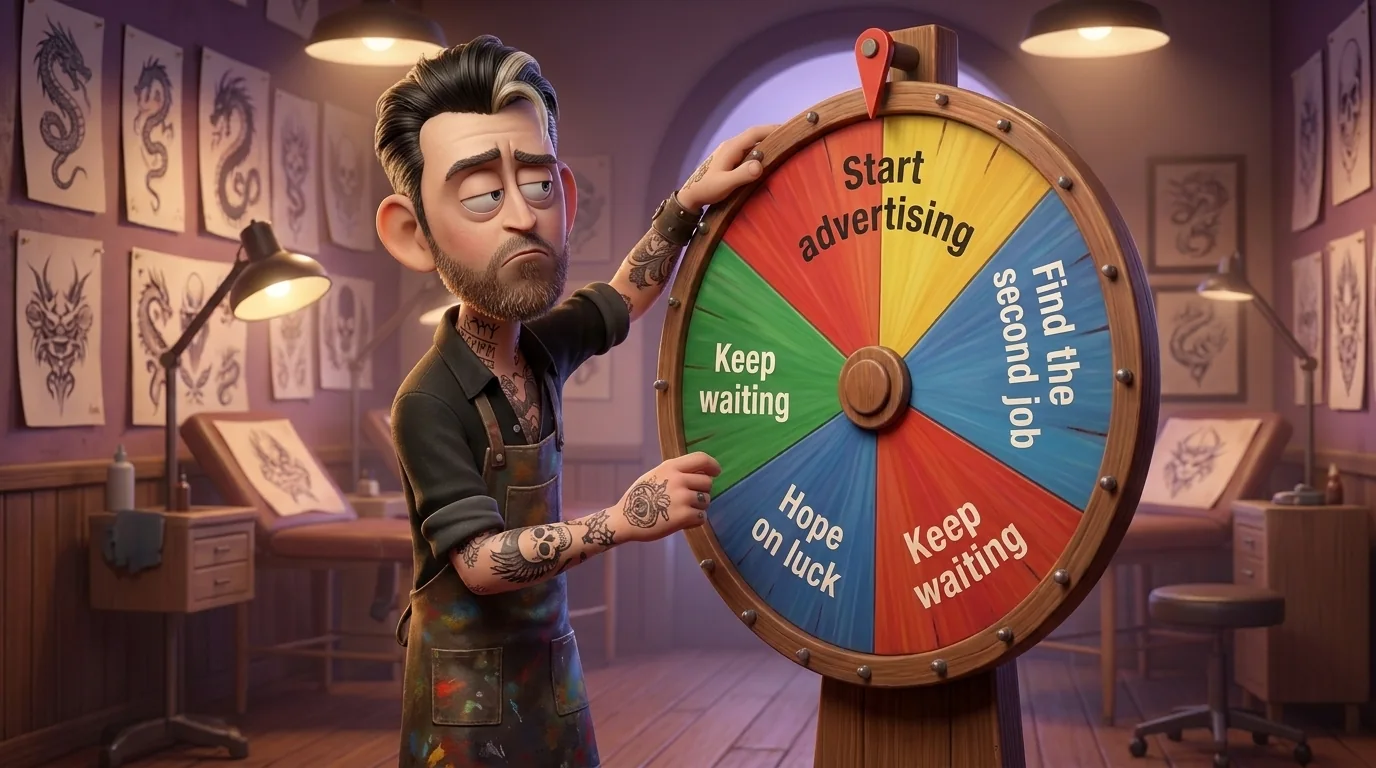
There's no universal answer for where to start - but here are recommendations for a few different situations. Pick what fits you best.
- If your calendar is completely empty and you need bookings fast - start with Meta Ads. All types of clients are there, including people ready to book right now. You have Instagram, you have work - run the ads. A budget of $200–$300 a month is enough to start.
- If you have a few weeks of clients booked, you feel the need for more, you have a website, and you have the budget - welcome to Google Ads. $500–$700 is enough. Do everything we talked about and keep an eye on the campaign. You'll get fewer leads but they'll be hotter. And if you already have Google My Business set up by the time you launch - oof, buckle up and get ready for a fully booked calendar.
- Does TikTok need another explanation? If everything is already working, you have clients, and you have great content - create a TikTok and start posting there too. Within two months you'll know if it's working for you. Don't start with paid ads there right away. You'll just burn through your money.
- And our beloved SEO. Everything's been said about it. You can work on it in parallel with everything else - it takes time, it requires learning new things, but it costs almost nothing. If you're sitting without clients right now, I have a great suggestion for how to spend a few free hours. And if you also build a website on top of that - what are you, a machine?
Final thoughts
Guys, before I wrap this up - a lot of you have incredible work. You deserve a line of clients waiting for you.
But advertising and client acquisition is that invisible part that gets artists with your level of work - sometimes better, sometimes worse - fully booked. It doesn't matter which method you choose. What matters is that you start. The moment you do, you're already ahead of most of your fellow artists.
Every campaign you run, even a small one, teaches you something. That understanding compounds. And one day you'll look back and be glad you started when you did. So, to beer or not to beer?
And if at some point it starts to feel like too much to figure out alone - here's how we work with tattoo artists.
How to Run Ads for Tattoo Artists: The Complete Guide
Most tattoo artists I talk to have the same problem: they don't know what next week looks like. A few weeks of bookings ahead at best - and plenty who genuinely don't know if they'll have clients at all.
Most have tried running ads - but "tried" usually means boosting a post for $50, watching it go nowhere, and writing off ads completely. Sound familiar? If that's your approach to advertising, you're better off spending that $50 on pizza and beer and having a good night instead.
But if you want to understand how advertising works - and you're not expecting to launch today and wake up booked three months out tomorrow - welcome to this guide.
Always look at the whole picture
People love giving the usual advice - and you actually can stick with them: "post more," "do your stories," "just boost a post," "add yourself to Google Maps." Will it work? Maybe. Maybe not. Maybe…
Before you follow anyone's advice, understand how your tattoo clients actually behave - and what types of clients exist. Without that, everything you try might bring clients in, or it might do absolutely nothing. And trust me, the second outcome is a lot more common than the first.
When it comes to advertising, most tattoo artists either don't believe it works - or if they try, 90% stop within the first week because they don't see results. Always keep this in mind: some clients are ready to book a session right now, some need help with the concept and they're yours the moment you offer it, and some will be thinking it over for days, weeks, or months. Your job as a tattoo artist is to become the obvious choice for all three. Build your advertising with that in mind - and everything starts to make more sense.
The Four Horsemen
There are four channels worth your attention: Meta (mostly Instagram), Google, TikTok, and organic SEO. All of these channels work with clients at different stages - don't take all of them at once, don't even think about it. Your goal after reading this article is to pick one channel and start building it.
Because I know the type - the ones who decide to launch all four channels at the same time. You'll burn out, you'll get frustrated, and then you'll come back and tell me my advice is bad. If that's your plan, you might as well stop reading right now.
Meta Ads
Every tattoo artist is on Instagram. Every. Single. One. Because that's where clients find you most often. They come here, see beautiful work, get inspired, and reach out to the artists they like - and/or start following them.
What is Meta Ads for?
This is the channel that reaches all three types of clients I mentioned above. Some will book a session with you tomorrow after seeing your ad. Others will follow you and message you two months later for multiple sessions.
A lot of artists start with boosting posts. That's great - it means you're already taking action. Now let's go a little deeper. I always recommend a two-campaign structure set up through Meta Ads Manager:
The first campaign is focused on conversations - you're pulling in people who are already ready and will message you, discuss their idea, and most likely book.
The second campaign is profile traffic. This one works especially well with the second and third type of client - people who haven't finalized their concept yet, but you can already become their go-to choice down the road. Together these two campaigns create consistent, steady growth. I personally know a tattoo artist working in a city where the max rate was $1,500 for a full session. After six solid months of Meta ads, he's booked two months out - and he's the first artist in that city charging $1,800.
I won't go into every detail about Meta here - I want to introduce you to each channel first. But if you want to go deeper on this one specifically, go here.
What it costs
Meta ads for tattoo artists typically run between $10–$30 per day for local campaigns. Cost per lead varies widely - artists doing smaller pieces regularly see leads at $3–5. For larger, high-commitment work, expect $8–10. If your numbers are higher than that, the issue is almost always the ad creatives - that's the first place I'd look.
Google Ads
Right now, somewhere in your area, multiple people searched "black & grey tattoo artist near me" today. And you didn't show up. Okay, okay - you'll say "well, that's not my style." And I'll say there were searches for every other style too. You weren't there either.
Google Ads is built specifically for that first type of client - the ones who have been ready to get tattooed for a while and are actively looking for someone to trust with it right now.
Where do I even start?
Google has a lot of campaign types, but as a tattoo artist, focus on one only - Search. You don't need to run multiple campaign types, chase potential clients on YouTube, or build complex funnels where you show up 15 times across different websites before someone finally fills out a form. Don't overcomplicate it. Overcomplicating is what info coaches do when their job is to sell you a course under the guise of "it's not as simple as it seems, but I'll show you how for just $1,399 - or $199 if you buy today."
Just Search. Your main goal with Google is to pull in people who are ready right now. To do that, build a keyword list like:
- "tattoo studio [city]"
- "cover up tattoo [neighborhood]"
- "fine line tattoo near me" etc.
The key things to remember: go narrow - keywords tied to city, style, specific location. Skip broad terms like "tattoo" or "tattoo ideas." Add also negative keywords and you're ready.
What it costs
Google Search ads require a minimum of $500/month. The algorithm needs data to optimize - with a smaller budget, it never gets enough conversions to learn. Cost per click in the tattoo niche ranges from $1.50 to $4.00 depending on the market. It also depends on your location, but you'll never know exactly until you launch. And don't forget your website - even the hottest leads won't reach out if your site is enough to ruin anyone’s appetite.
TikTok Ads
TikTok is the youngest channel on this list and the least predictable. I won't spend too much time on it, but from my own experience - tattoo artists working in younger styles, like anime tattoos, can absolutely find their audience here.
And while this article is focused on advertising, I'll say this about TikTok specifically: you can go purely organic here and get clients through great content alone. But again - artists working in newer styles will find their people here. If you're doing black & grey, traditional, color realism, or other styles where your audience tends to be 25-30+ - look at the other channels first.
SEO
All the channels we've covered so far are paid. And they work only as long as you keep paying. SEO is the channel I love most - but it's not for everyone. Yes, it's free. But yes, you have to work on it consistently. To make it easier to understand, let's split SEO into two parts: Google My Business and your website.
Google My Business
More than 60% of people who search on Google check the Maps results. This is your golden Willy Wonka ticket. Do you have your own pin on Google Maps? Great. If not - do it today. Register, fill it out with information, a description, photos - and then ask every current and past client who can leave you a good review to do exactly that. You'll thank me later. These steps alone will start bringing you clients from time to time. You won't be able to predict how often or how many - but they will come, guaranteed. And make sure clients can reach you - add your website. No website? Add your Instagram.
Website
This is the second part of SEO - harder and slower to build, but the results are significantly better. Let's be honest though: if you're a tattoo artist who just wants clients so you stop worrying about tomorrow - this isn't your path. If you have a private studio, other artists working with you, and you're gradually moving from artist to studio owner - then think seriously about this channel. Otherwise, just build a clean website, fill it with information, add your portfolio, connect it to Google My Business - and that's it. You could be stubborn and decide to go all in on SEO, but trust me - you'll be competing against studios with money and dedicated SEO specialists. That's a race you'll lose going solo. And I'm not even getting into backlinks… brrr. Anyone who knows what those are and how hard it is to find the right ones - I feel you.
Good SEO results take time, but what I've described can start bringing you clients within the next few months. Most people who read this will forget about it and do nothing - and that's fine. This article is for the ones who actually do things. What we talked about will take you a few hours to set up. But it's enough to start bringing in clients and take that edge off when rent is due.
How to decide where to start
There's no universal answer for where to start - but here are recommendations for a few different situations. Pick what fits you best.
- If your calendar is completely empty and you need bookings fast - start with Meta Ads. All types of clients are there, including people ready to book right now. You have Instagram, you have work - run the ads. A budget of $200–$300 a month is enough to start.
- If you have a few weeks of clients booked, you feel the need for more, you have a website, and you have the budget - welcome to Google Ads. $500–$700 is enough. Do everything we talked about and keep an eye on the campaign. You'll get fewer leads but they'll be hotter. And if you already have Google My Business set up by the time you launch - oof, buckle up and get ready for a fully booked calendar.
- Does TikTok need another explanation? If everything is already working, you have clients, and you have great content - create a TikTok and start posting there too. Within two months you'll know if it's working for you. Don't start with paid ads there right away. You'll just burn through your money.
- And our beloved SEO. Everything's been said about it. You can work on it in parallel with everything else - it takes time, it requires learning new things, but it costs almost nothing. If you're sitting without clients right now, I have a great suggestion for how to spend a few free hours. And if you also build a website on top of that - what are you, a machine?
Final thoughts
Guys, before I wrap this up - a lot of you have incredible work. You deserve a line of clients waiting for you.
But advertising and client acquisition is that invisible part that gets artists with your level of work - sometimes better, sometimes worse - fully booked. It doesn't matter which method you choose. What matters is that you start. The moment you do, you're already ahead of most of your fellow artists.
Every campaign you run, even a small one, teaches you something. That understanding compounds. And one day you'll look back and be glad you started when you did. So, to beer or not to beer?
And if at some point it starts to feel like too much to figure out alone - here's how we work with tattoo artists.
How to Run Ads for Tattoo Artists: The Complete Guide
Most tattoo artists I talk to have the same problem: they don't know what next week looks like. A few weeks of bookings ahead at best - and plenty who genuinely don't know if they'll have clients at all.
Most have tried running ads - but "tried" usually means boosting a post for $50, watching it go nowhere, and writing off ads completely. Sound familiar? If that's your approach to advertising, you're better off spending that $50 on pizza and beer and having a good night instead.
But if you want to understand how advertising works - and you're not expecting to launch today and wake up booked three months out tomorrow - welcome to this guide.
Always look at the whole picture
People love giving the usual advice - and you actually can stick with them: "post more," "do your stories," "just boost a post," "add yourself to Google Maps." Will it work? Maybe. Maybe not. Maybe…
Before you follow anyone's advice, understand how your tattoo clients actually behave - and what types of clients exist. Without that, everything you try might bring clients in, or it might do absolutely nothing. And trust me, the second outcome is a lot more common than the first.
When it comes to advertising, most tattoo artists either don't believe it works - or if they try, 90% stop within the first week because they don't see results. Always keep this in mind: some clients are ready to book a session right now, some need help with the concept and they're yours the moment you offer it, and some will be thinking it over for days, weeks, or months. Your job as a tattoo artist is to become the obvious choice for all three. Build your advertising with that in mind - and everything starts to make more sense.
The Four Horsemen
There are four channels worth your attention: Meta (mostly Instagram), Google, TikTok, and organic SEO. All of these channels work with clients at different stages - don't take all of them at once, don't even think about it. Your goal after reading this article is to pick one channel and start building it.
Because I know the type - the ones who decide to launch all four channels at the same time. You'll burn out, you'll get frustrated, and then you'll come back and tell me my advice is bad. If that's your plan, you might as well stop reading right now.
Meta Ads
Every tattoo artist is on Instagram. Every. Single. One. Because that's where clients find you most often. They come here, see beautiful work, get inspired, and reach out to the artists they like - and/or start following them.
What is Meta Ads for?
This is the channel that reaches all three types of clients I mentioned above. Some will book a session with you tomorrow after seeing your ad. Others will follow you and message you two months later for multiple sessions.
A lot of artists start with boosting posts. That's great - it means you're already taking action. Now let's go a little deeper. I always recommend a two-campaign structure set up through Meta Ads Manager:
The first campaign is focused on conversations - you're pulling in people who are already ready and will message you, discuss their idea, and most likely book.
The second campaign is profile traffic. This one works especially well with the second and third type of client - people who haven't finalized their concept yet, but you can already become their go-to choice down the road. Together these two campaigns create consistent, steady growth. I personally know a tattoo artist working in a city where the max rate was $1,500 for a full session. After six solid months of Meta ads, he's booked two months out - and he's the first artist in that city charging $1,800.
I won't go into every detail about Meta here - I want to introduce you to each channel first. But if you want to go deeper on this one specifically, go here.
What it costs
Meta ads for tattoo artists typically run between $10–$30 per day for local campaigns. Cost per lead varies widely - artists doing smaller pieces regularly see leads at $3–5. For larger, high-commitment work, expect $8–10. If your numbers are higher than that, the issue is almost always the ad creatives - that's the first place I'd look.
Google Ads
Right now, somewhere in your area, multiple people searched "black & grey tattoo artist near me" today. And you didn't show up. Okay, okay - you'll say "well, that's not my style." And I'll say there were searches for every other style too. You weren't there either.
Google Ads is built specifically for that first type of client - the ones who have been ready to get tattooed for a while and are actively looking for someone to trust with it right now.
Where do I even start?
Google has a lot of campaign types, but as a tattoo artist, focus on one only - Search. You don't need to run multiple campaign types, chase potential clients on YouTube, or build complex funnels where you show up 15 times across different websites before someone finally fills out a form. Don't overcomplicate it. Overcomplicating is what info coaches do when their job is to sell you a course under the guise of "it's not as simple as it seems, but I'll show you how for just $1,399 - or $199 if you buy today."
Just Search. Your main goal with Google is to pull in people who are ready right now. To do that, build a keyword list like:
- "tattoo studio [city]"
- "cover up tattoo [neighborhood]"
- "fine line tattoo near me" etc.
The key things to remember: go narrow - keywords tied to city, style, specific location. Skip broad terms like "tattoo" or "tattoo ideas." Add also negative keywords and you're ready.
What it costs
Google Search ads require a minimum of $500/month. The algorithm needs data to optimize - with a smaller budget, it never gets enough conversions to learn. Cost per click in the tattoo niche ranges from $1.50 to $4.00 depending on the market. It also depends on your location, but you'll never know exactly until you launch. And don't forget your website - even the hottest leads won't reach out if your site is enough to ruin anyone’s appetite.
TikTok Ads
TikTok is the youngest channel on this list and the least predictable. I won't spend too much time on it, but from my own experience - tattoo artists working in younger styles, like anime tattoos, can absolutely find their audience here.
And while this article is focused on advertising, I'll say this about TikTok specifically: you can go purely organic here and get clients through great content alone. But again - artists working in newer styles will find their people here. If you're doing black & grey, traditional, color realism, or other styles where your audience tends to be 25-30+ - look at the other channels first.
SEO
All the channels we've covered so far are paid. And they work only as long as you keep paying. SEO is the channel I love most - but it's not for everyone. Yes, it's free. But yes, you have to work on it consistently. To make it easier to understand, let's split SEO into two parts: Google My Business and your website.
Google My Business
More than 60% of people who search on Google check the Maps results. This is your golden Willy Wonka ticket. Do you have your own pin on Google Maps? Great. If not - do it today. Register, fill it out with information, a description, photos - and then ask every current and past client who can leave you a good review to do exactly that. You'll thank me later. These steps alone will start bringing you clients from time to time. You won't be able to predict how often or how many - but they will come, guaranteed. And make sure clients can reach you - add your website. No website? Add your Instagram.
Website
This is the second part of SEO - harder and slower to build, but the results are significantly better. Let's be honest though: if you're a tattoo artist who just wants clients so you stop worrying about tomorrow - this isn't your path. If you have a private studio, other artists working with you, and you're gradually moving from artist to studio owner - then think seriously about this channel. Otherwise, just build a clean website, fill it with information, add your portfolio, connect it to Google My Business - and that's it. You could be stubborn and decide to go all in on SEO, but trust me - you'll be competing against studios with money and dedicated SEO specialists. That's a race you'll lose going solo. And I'm not even getting into backlinks… brrr. Anyone who knows what those are and how hard it is to find the right ones - I feel you.
Good SEO results take time, but what I've described can start bringing you clients within the next few months. Most people who read this will forget about it and do nothing - and that's fine. This article is for the ones who actually do things. What we talked about will take you a few hours to set up. But it's enough to start bringing in clients and take that edge off when rent is due.
How to decide where to start
There's no universal answer for where to start - but here are recommendations for a few different situations. Pick what fits you best.
- If your calendar is completely empty and you need bookings fast - start with Meta Ads. All types of clients are there, including people ready to book right now. You have Instagram, you have work - run the ads. A budget of $200–$300 a month is enough to start.
- If you have a few weeks of clients booked, you feel the need for more, you have a website, and you have the budget - welcome to Google Ads. $500–$700 is enough. Do everything we talked about and keep an eye on the campaign. You'll get fewer leads but they'll be hotter. And if you already have Google My Business set up by the time you launch - oof, buckle up and get ready for a fully booked calendar.
- Does TikTok need another explanation? If everything is already working, you have clients, and you have great content - create a TikTok and start posting there too. Within two months you'll know if it's working for you. Don't start with paid ads there right away. You'll just burn through your money.
- And our beloved SEO. Everything's been said about it. You can work on it in parallel with everything else - it takes time, it requires learning new things, but it costs almost nothing. If you're sitting without clients right now, I have a great suggestion for how to spend a few free hours. And if you also build a website on top of that - what are you, a machine?
Final thoughts
Guys, before I wrap this up - a lot of you have incredible work. You deserve a line of clients waiting for you.
But advertising and client acquisition is that invisible part that gets artists with your level of work - sometimes better, sometimes worse - fully booked. It doesn't matter which method you choose. What matters is that you start. The moment you do, you're already ahead of most of your fellow artists.
Every campaign you run, even a small one, teaches you something. That understanding compounds. And one day you'll look back and be glad you started when you did. So, to beer or not to beer?
And if at some point it starts to feel like too much to figure out alone - here's how we work with tattoo artists.
Keep reading
All stories →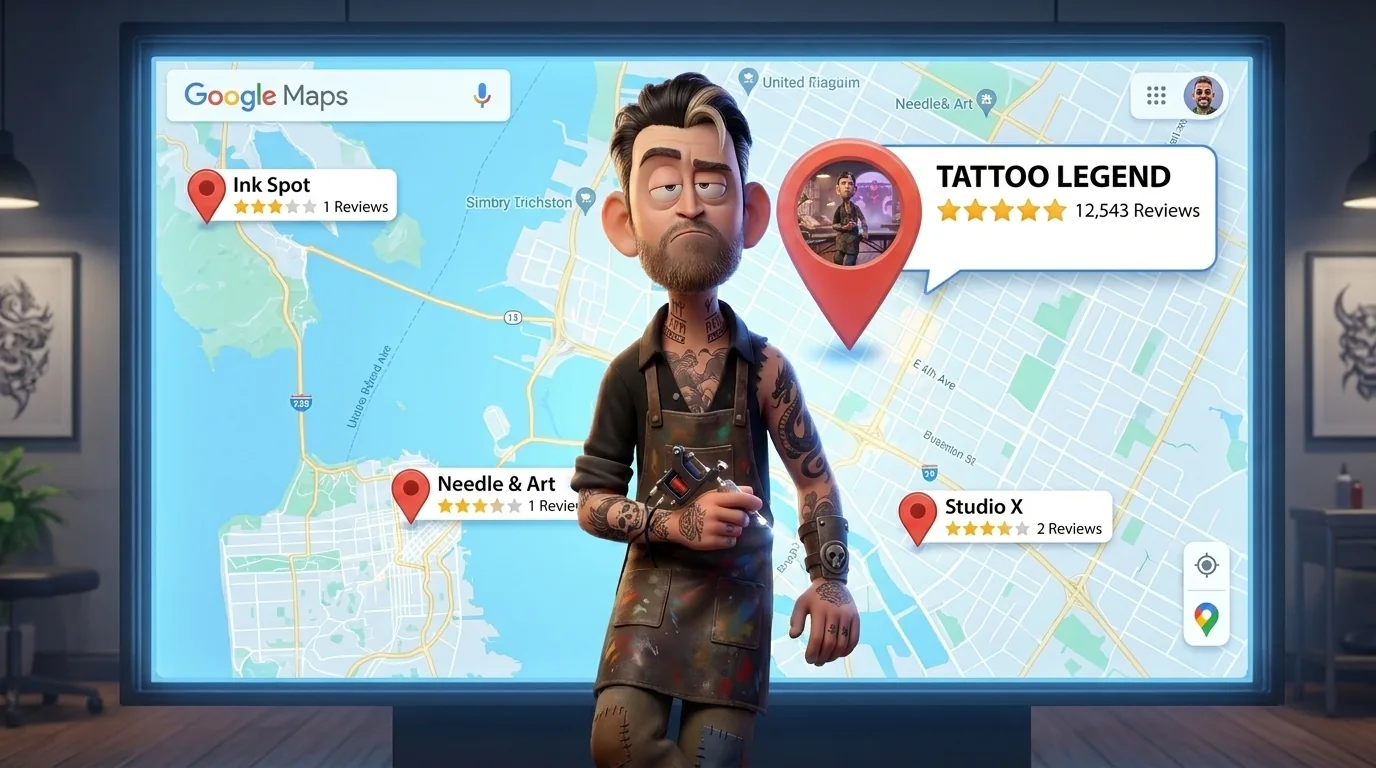
No time to read right now?
Drop your email and we'll send the best growth playbooks, case breakdowns and booking tactics straight to your inbox. One sharp email, twice a month — no spam, unsubscribe anytime.
No time to read right now?
Drop your email and we'll send the best growth playbooks, case breakdowns and booking tactics straight to your inbox. One sharp email, twice a month — no spam, unsubscribe anytime.
No time to read right now?
Drop your email and we'll send the best growth playbooks, case breakdowns and booking tactics straight to your inbox. One sharp email, twice a month — no spam, unsubscribe anytime.